





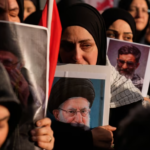
After Iraq: How Iran Built a Military System Designed to Survive U.S. Airpower
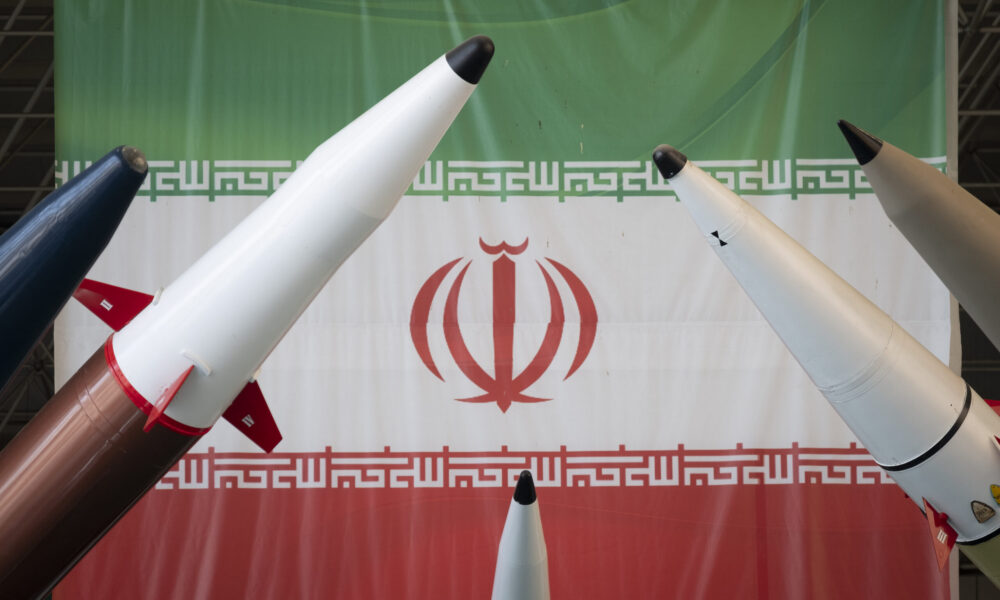
From the destruction of Iraq’s military during the 1991 Gulf War to the swift collapse of Saddam Hussein’s forces during the 2003 invasion of Iraq, modern air campaigns have repeatedly demonstrated the devastating effectiveness of advanced airpower. Precision strikes can cripple centralised command systems, decapitate leadership structures, and unravel the operational coherence of a conventional army within days.
Iran studied those wars closely and drew a different set of conclusions. Rather than attempting to match the United States in conventional military power, the Islamic Republic began constructing a military system designed for endurance: one built to absorb shock, preserve continuity, and sustain offensive capability even under relentless aerial bombardment.
The real question, therefore, is not whether Iran can withstand individual strikes. It is whether a state that cannot compete symmetrically with the United States can nonetheless build a warfighting architecture capable of denying the Western Empire the kind of rapid, paralysing victory it once achieved against Iraq.
Operation Desert Storm
The air campaign of the Gulf War began on 17 January 1991 as part of Operation Desert Storm, following months of coalition mobilisation after Iraq’s invasion of Kuwait in August 1990.
The United States and its allies assembled one of the largest air armadas in modern military history. Aircraft from multiple coalition states conducted sustained bombing operations against Iraqi targets across both Kuwait and Iraq. The central objective of the campaign was clear: dismantle Iraq’s Soviet inherited integrated air defence system, sever its command-and-control networks, and degrade the Iraqi military’s ability to supply and coordinate its forces, particularly those occupying Kuwait.
American planners understood that modern war could be decided before the ground battle even began. The first wave of attacks therefore focused on paralysing Iraq’s air defence network. Stealth aircraft such as the F-117 Nighthawk struck radar installations and command facilities in Baghdad. Cruise missiles launched from ships and submarines in the Persian Gulf targeted communications centres and power infrastructure. Electronic warfare aircraft jammed Iraqi radar systems while fighter jets intercepted Iraqi aircraft attempting to respond.
Within days, Iraq’s air defence network had been severely degraded, allowing coalition aircraft to operate over Iraqi territory with minimal resistance.
Another key objective was to cripple the Iraqi government’s ability to coordinate both military and civilian systems. Over the course of the campaign, coalition aircraft flew tens of thousands of sorties and dropped vast quantities of conventional munitions across strategic infrastructure and military targets.
A major component of the air war involved isolating Iraqi forces stationed in Kuwait. Coalition aircraft systematically struck supply lines, bridges, and logistical hubs linking Iraqi units in Kuwait with their bases inside Iraq. Tanks, armoured vehicles, artillery positions, and troop formations were repeatedly targeted from the air.
By the time the ground war began, Iraqi forces had already been severely weakened by weeks of relentless bombardment. After thirty-eight days of continuous air attacks, coalition forces launched their ground offensive. The Iraqi army, already degraded and disorganised, collapsed with remarkable speed. Coalition troops recaptured Kuwait in roughly one hundred hours, marking one of the shortest large scale ground campaigns in modern history.
The significance of the campaign lay not only in the destruction it inflicted, but in the strategic lesson it appeared to confirm. A centralised army, dependent on intact command nodes, communications systems, and fixed infrastructure, could be systematically dismantled from the air before it had any meaningful opportunity to recover.
The 2003 Iraq War
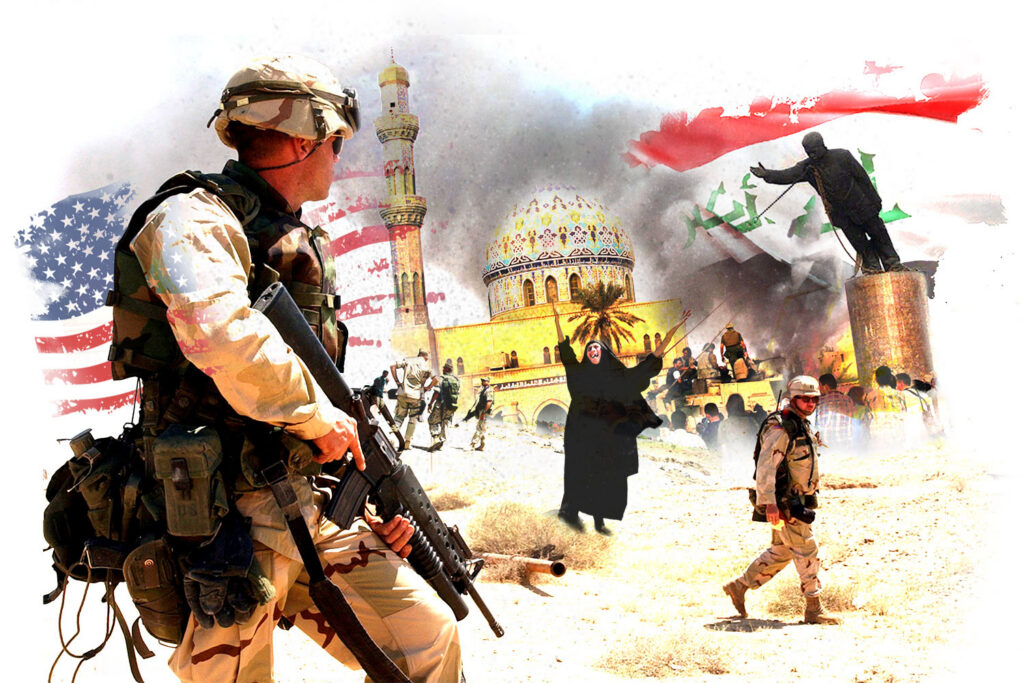
Twelve years later, the United States returned to Iraq, launching the invasion that would topple Saddam Hussein’s government.
The air campaign accompanying the invasion became synonymous with the doctrine of “shock and awe”, a strategy designed to overwhelm the enemy both psychologically and militarily through a display of overwhelming force. The objective was not merely the destruction of military assets, but the creation of such intense shock, destruction, and disorientation that Iraqi leadership and military units would rapidly lose both the capacity and the will to fight.
The first strikes began on 19 March 2003, targeting locations believed to house Iraqi leadership. Within days, a large-scale bombing campaign unfolded across the country, striking military facilities, government infrastructure, and strategic installations throughout Iraq. Explosions across Baghdad were broadcast globally, reinforcing the spectacle of overwhelming American military power.
Unlike the Gulf War, the 2003 invasion combined sustained airpower with a rapid ground advance. Coalition forces pushed north from Kuwait toward Baghdad while air strikes cleared the path ahead, targeting Iraqi defensive positions encountered by advancing ground units. Aircraft destroyed tanks, artillery batteries, and troop concentrations as coalition forces advanced.
Within three weeks, U.S. forces had entered Baghdad. The Iraqi military disintegrated during the invasion. Many units abandoned their positions or surrendered, while others simply dispersed without organised resistance. On 9 April 2003, U.S. forces seized central Baghdad, effectively bringing Saddam Hussein’s government to an end.
Both wars demonstrated the same underlying principle. Precision guided munitions, integrated intelligence networks linking satellites, surveillance aircraft, and command centres, and the ability to sustain high intensity bombardment enabled U.S. forces to dismantle Iraq’s military infrastructure with extraordinary speed.
A central element of both campaigns was the systematic destruction of leadership and communication nodes. By severing command structures, the air campaigns sought to paralyse the enemy’s ability to coordinate resistance. The scale and intensity of the bombing were intended not only to destroy infrastructure, but to shatter morale.
The Gulf War and the 2003 invasion therefore became defining demonstrations of modern Western war system. Through technological dominance, precision targeting, and sustained aerial assault, the United States and its allies dismantled Iraq’s conventional military power in a matter of weeks.
Yet these conflicts also exposed the limits of battlefield victory. Iraq’s army collapsed quickly in both wars, but the political and security consequences that followed proved far more complex and enduring than the speed of the initial military triumph suggested. That distinction is crucial, because battlefield dominance does not automatically translate into strategic resolution.
Lessons Drawn by the Iranian Security Establishment
The current confrontation involving Iran, the United States, and Israel represents the clearest test yet of Iran’s decades-long effort to build a military system capable of surviving sustained Western airpower. For years, Iranian strategic thinking has centred on a simple conclusion: the kind of centralised military structure that collapsed so quickly in Iraq cannot survive against a technologically superior adversary.
Iran’s answer was to construct a system built around decentralisation, dispersion, endurance, and the ability to continue fighting even after absorbing devastating initial strikes.
Two American wars fundamentally shaped this strategic outlook. The first was the 1991 war against Saddam Hussein’s Iraq. The second came in 2003.
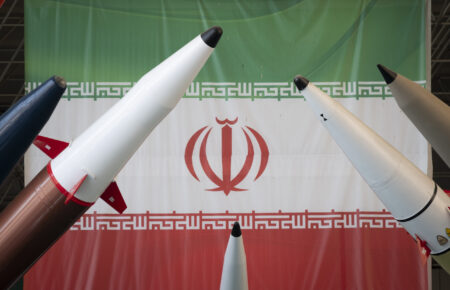
International sanctions and prolonged military isolation prevented Iran from building a modern air force capable of competing on a conventional level with the United States or Israel. Rather than pursuing an unwinnable race in predictable airpower, Iranian planners invested heavily in ballistic missile and drone programmes as alternative forms of deterrence.
Over time, Iranian military doctrine increasingly emphasised asymmetry, dispersed readiness, and the ability to sustain combat operations even after key command centres had been struck.
This thinking produced what became known as the mosaic defence doctrine. Under this system, the Islamic Revolutionary Guard Corps (IRGC) and Islamic Republic of Iran Army (Artesh-e Jomhuri-ye Eslami-ye Iran) divide the country into semi-autonomous operational sectors. Each sector maintains its own command structures, logistics networks, and military units. If national command centres are destroyed, local units are expected to continue operating independently rather than waiting for centralised direction.
The logic behind this structure is straightforward. A military organised around rigid command hierarchies can be paralysed if its leadership and communications nodes are destroyed. A decentralised system, by contrast, is designed to continue functioning even after severe disruption.
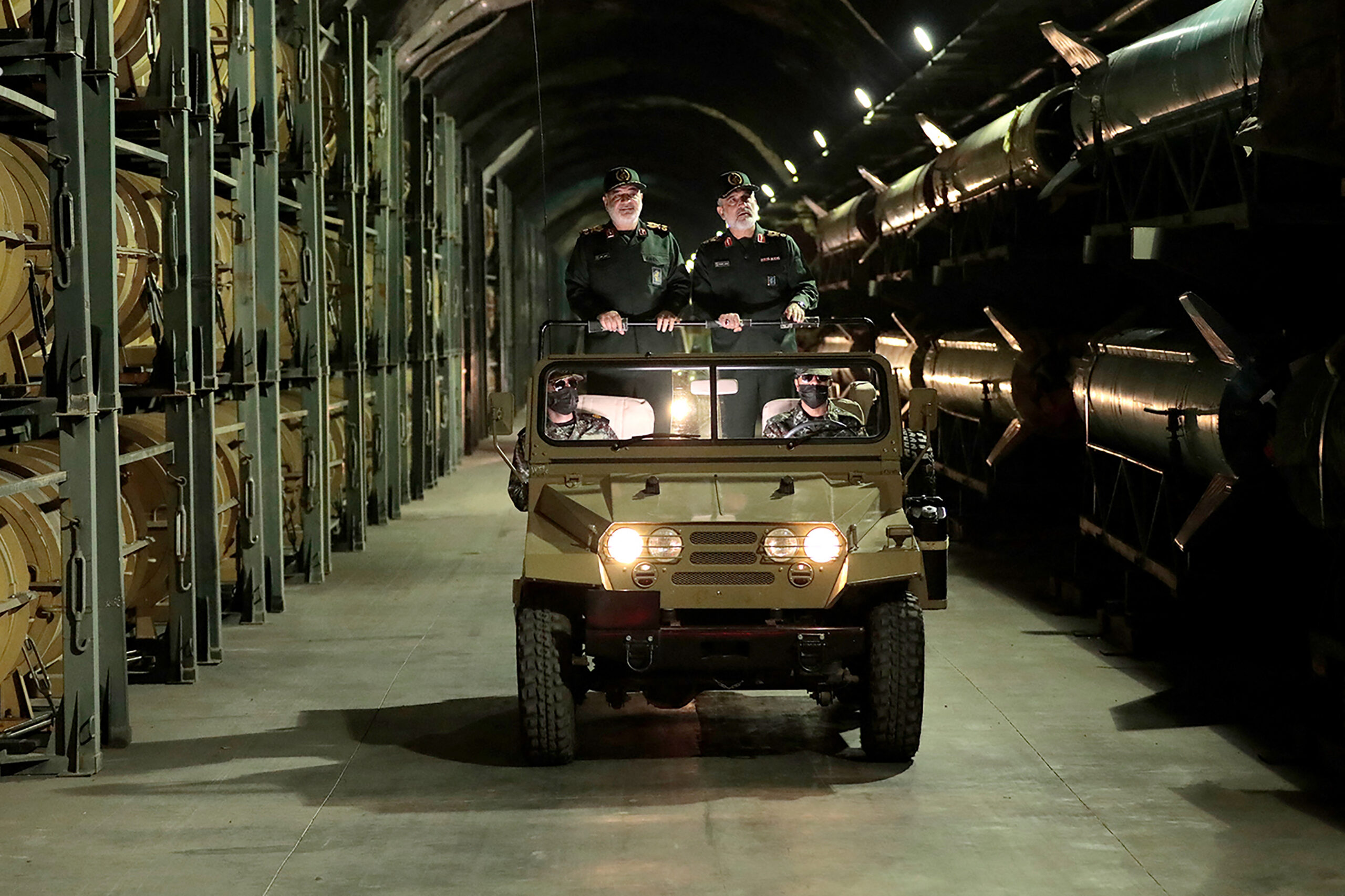
Missile launchers, drone facilities, and logistical depots have therefore been dispersed across numerous locations. Many are embedded in mountainous terrain or housed in underground facilities built to withstand repeated bombardment. Iran’s geography further reinforces this strategy. Its vast territory, difficult terrain, and infrastructural depth complicate the kind of rapid air dominance campaign that proved decisive against Iraq.
The lesson Iran drew from Iraq was not simply that the United States possesses superior firepower. It was that modern American warfighting relies on transforming that firepower into paralysis. Iran’s response was to build a military system specifically designed to resist that outcome.
Shock and Immediate Response
The opening phase of the current war followed a pattern that has become familiar in modern American and Israeli war strategy. The confrontation began on 28 February 2026 with coordinated strikes against Iranian military infrastructure, missile facilities, air defence systems, and leadership compounds. From the outset, the objective echoed the logic of earlier campaigns against Iraq: degrade strategic assets, disrupt command structures, and establish the conditions for sustained air superiority.
Follow-on strikes targeted intelligence facilities, internal security installations, and regional military positions. Yet despite the scale of these attacks, Iranian missile and drone launches continued.
That continuity is the critical detail. The significance of the opening exchange lies not simply in what was struck, but in the fact that the war did not halt with the destruction of fixed targets. The ability to continue launching missiles and drones even after sustained bombardment suggests a system designed to absorb the initial shock of modern airpower without collapsing operationally.
The early waves of drone and missile attacks also appear to have served a secondary purpose. Beyond immediate retaliation, they functioned as probes against regional air defence systems. In conflicts of this nature, the opening phase is not always about achieving instant strategic breakthrough. It is often about forcing defensive systems into constant engagement, exhausting interceptor stockpiles, mapping response patterns, and exposing vulnerabilities through sustained pressure.
Each stage of the exchange reflects a military structure shaped by years of preparation for precisely this scenario. A state expecting to fight under bombardment does not rely on uninterrupted calm. It builds systems designed to function through disruption, sustain retaliation under pressure, and deny an adversary the rapid paralysis on which its doctrine depends.
Expanding the Battlefield
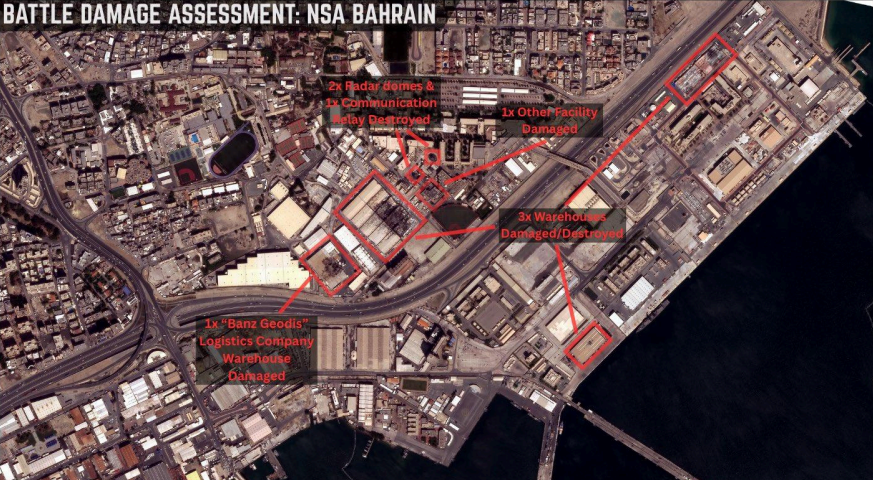
The conflict has not remained confined to a single front. It has begun to expand across the region.
Resistance factions within the Axis of Resistance, including Kataib Hezbollah and Harakat Hezbollah al-Nujaba, have carried out attacks against American forces stationed in Iraqi Kurdistan. At the same time, South Lebanon’s Hezbollah has launched rocket fire toward northern Israel while targeting newly established Israeli forward operating bases along the frontier.
In Yemen, AnsarAllah has signalled its readiness to open an active military front against the United States and Israel should the GCC states formally enter the war.
These developments reflect a strategic environment fundamentally different from the wars once fought against Iraq. In those conflicts, the battlefield remained largely confined to Iraqi territory. Iran’s strategic position is not defined by a single front. It exists within a broader regional landscape shaped by alliances, ideological affinity, and shared confrontation with American and Israeli power.
This network allows pressure to emerge simultaneously across multiple theatres. Coordination with these regional allies appears to have been established before hostilities began, but the pattern of activity suggests deliberate restraint rather than immediate full activation.
Instead of unleashing every front at once, the strategy appears to favour phased escalation. Pressure can be applied gradually while preserving the option to widen the conflict if necessary.
The effect is to stretch the geography of the war itself. Rather than concentrating the confrontation within one territory, the battlefield begins to extend across the region, complicating any attempt to isolate the conflict or contain its consequences.
Energy Warfare and the Strait of Hormuz
Energy has become one of the most consequential dimensions of the conflict. The Strait of Hormuz remains one of the central chokepoints of the global energy system, with roughly one fifth of the world’s oil trade passing through it prior to the outbreak of war.
For Iran, the strait is not merely a maritime passage. It is a form of strategic depth. Control over such a critical artery means that a regional confrontation can quickly reverberate far beyond the battlefield itself.
The importance of Hormuz therefore lies in more than the immediate effect on oil prices. Disruption in the strait extends the conflict into the circulatory system of the global economy. Energy flows, maritime trade, shipping insurance, inflationary pressures, and financial markets all become exposed to the consequences of war.
In this sense, the strait transforms the character of the conflict. Military pressure applied in the Persian Gulf does not remain confined to a regional theatre. It radiates outward through global energy markets and trade networks.
Strikes on GCC energy infrastructure, or even the credible threat of disrupting shipping through Hormuz, therefore operate as more than tactical pressure. They shift the confrontation from a question of battlefield attrition to one of systemic economic strain.
Escalation and Systemic Strain
By the second week of the war, several broader patterns had begun to emerge. Iranian strikes continued while pressure expanded across the GCC. At the same time, the strain placed on regional missile defence systems became increasingly visible as repeated waves of drones and missiles forced defensive networks into constant engagement.
The confrontation began to reveal a deeper dynamic. Escalation with Iran was never likely to resemble a single “shock and awe” moment capable of producing rapid collapse. Instead, the conflict has increasingly taken the shape of cumulative disruption: pressure spreading simultaneously across military, economic, and political domains.
Iranian officials and resistance factions’ spokespersons have framed the war in precisely these terms, as a conflict of attrition. In such a contest, the decisive variable is not which side appears dominant in the opening exchanges, but which can sustain operational continuity, impose expanding costs, and prevent the other from converting early military advantage into strategic resolution.
At the same time, the possibility of additional fronts has continued to surface. Discussions in Washington about potential Kurdish involvement along Iran’s western frontier illustrate the broader logic that often follows when initial bombardment fails to produce decisive collapse. External pressure is supplemented by attempts to activate internal fractures and auxiliary theatres of confrontation.
The wider implication is that escalation does not unfold in a straight line. It accumulates through systemic stress. Each additional front, each new strike on infrastructure, and each disruption to energy flows or trade routes deepens the pressure on the entire regional order.
The longer such pressures accumulate, the harder it becomes to sustain the idea that the conflict can remain geographically or politically contained.
When Airpower Meets Endurance
The United States retains overwhelming technological superiority and the capacity to sustain large scale aerial bombardment across the region. That reality is undeniable.
Iran, however, has spent decades preparing for precisely this scenario. Through the development of an indigenous missile programme, the strengthening of domestic air defence, the dispersal of critical infrastructure, the decentralisation of military command, and the strategic leverage of chokepoints such as the Strait of Hormuz, Tehran has attempted to construct a system designed to absorb the initial shock of modern airpower while extending the costs of war outward.
The doctrines often described as mosaic defence and forward defence reflect that effort. They are not attempts to match American power symmetrically, but to neutralise the strategic logic on which that power relies.
What is now unfolding is therefore not simply a contest between stronger and weaker firepower. It is a test of whether endurance can deny technologically superior powers the rapid, paralysing victory that has long defined their doctrine of war.
If the Islamic Republic’s system succeeds, even partially, in prolonging the conflict and amplifying its economic and geopolitical consequences, then the central lesson of this war will not lie in missiles alone.
It will lie in whether a state without nuclear weapons can withstand the opening violence of modern Western airpower without collapsing into the kind of military paralysis that destroyed Iraq.
That is the strategic question this war has now forced into the open.

No Comment! Be the first one.