




The Gospel of Barnabas and the True Gospel of Jesus: How the Christian Empire Reshaped the Message of Christ
“Then God gave his soul to man, while all the holy angels sang ‘Blessed be your holy name, O God our Lord’. Adam, having sprung upon his feet, saw in the air a writing that shone like the sun, which said ‘There is only one God, and Muhammad is the Messenger of God.’” (The Gospel of Barnabas, chapter 39)
When we refer to the Gospel of Jesus Christ today, it is generally understood to mean the four gospels in the New Testament attributed to Matthew, Mark, Luke, and John. Although these texts bear the names of the disciples who lived with Jesus and witnessed his prophethood, a significant body of modern scholarship acknowledges that at least two are not based on direct eyewitness accounts, but instead draw from apostolic testimony, particularly that associated with Peter and Paul.
The gospels themselves were effectively anonymous when first circulated, and the identities of their authors were not formally attributed until the second century after Christ. Across the three Synoptic Gospels – Matthew, Mark, and Luke – the content remains broadly aligned despite being written by different individuals at different times, with even notable contradictions often explained away as “complementary perspectives”. The Gospel of John, however, stands apart, adopting a more overtly theological framing of Jesus’ ministry.
In his book Religions of the World, Gerald L. Berry writes:
“Although named after the four disciples, they were not written by them. No doubt a biography of Jesus in his own language, Aramaic, was written, and the Gospels were drawn from this, although the original is now lost. The Gospels were written Greek, a generation or two after Christ – the earliest one, Mark, about the year 65, and the latest, John, about 100.”
The forgery of documents, and their false attribution to disciples and even earlier prophets, was not an isolated occurrence, but a practice acknowledged within early Christian history. Paul himself warns of such distortions in his writings, and Bishop Dionysus of Corinth (circa 171 AD) writes:
“As the brethren desired me to write epistles, I did so, and these the apostles of the devil have filled with tares (undesirable elements), exchanging some things and adding others, for whom there is a woe reserved. It is not, therefore, a matter of wonder if some have also attempted to adulterate the sacred writings of the Lord, since they have attempted the same in other works that are not to be compared with these.”
M.A. Yusseff argues in The Scrolls, the Gospel of Barnabas, and the New Testament that the inclusion of the four gospels in the New Testament was not necessarily due to their inherent authenticity, but rather because they were used within the most prominent and influential church centres. It has also been widely acknowledged that there are more than ten thousand manuscript copies in the possession of the Church, dating between the second and fifteenth centuries, with none tracing directly to the earliest period.
Yusseff further posits that, because of what he terms the Nicolaitan Conspiracy, “which did not stop with the death of Paul since he was not its founder, the Christians do not have the authentic Gospel of Jesus in their possession.”
Taken together, along with a broader body of historical and textual evidence, this makes it increasingly difficult to dismiss the possibility that the Bible, as it exists today, has undergone layers of transmission, alteration, and selection over centuries, with entire books removed and sections introduced long after their original composition. Even within Christianity itself, there is no single unified canon. Catholic and Orthodox Churches do not use identical versions of the Bible to those used by Protestant traditions, owing to theological and historical differences. The Protestant canon, for instance, excludes books such as Judith, 1 and 2 Maccabees, and Baruch.
Among the most striking omissions, however, is the Gospel of Barnabas, which has been reported in some accounts to have been accepted within the canon of certain early Christian communities, including those associated with Alexandria, prior to 325 AD. That same year, the First Council of Nicaea was convened to establish doctrinal unity across the Christian world, most notably affirming the divine nature of Jesus as the Son of God.
It has been alleged that the Council ordered all original gospels in Hebrew to be destroyed, with possession of such texts punishable by death. While no surviving official decree explicitly confirms such an order, historical patterns indicate that writings which did not align with the emerging orthodoxy were progressively excluded, marginalised, and removed from mainstream circulation. Whether through direct enforcement or a gradual process of consolidation, alternative accounts became increasingly difficult to access after this period.
This raises unavoidable questions. Why were certain books preserved while others disappeared? Why were some writings accepted within earlier communities, only to be rejected later?
The answers may lie in the Gospel of Barnabas.
A Witness That Did Not Survive the Canon
So who was Barnabas? Although perhaps unfamiliar to many Christians today, and therefore easily dismissed, Barnabas is presented within early Christian sources as a disciple of Jesus, a position supported by references found in Christian writings as well as in Paul’s Acts of the Apostles. In Clement of Rome’s works, Recognitions and Homilies, it is stated that Matthias was another name for the disciple Barnabas, identifying him as one of the original twelve apostles of Jesus.
The question of differing names cannot be used as a sufficient argument against Barnabas, nor as grounds to discredit him or his Gospel, as variation in naming appears across the accepted New Testament texts themselves. For example, Lebbaeus in Matthew is referred to as Thaddeus in Mark, and as Judas son of James in both Luke and Acts. Such inconsistencies are not treated as disqualifying elsewhere, and cannot selectively be applied here.
In Paul’s Acts of the Apostles, where Barnabas is mentioned several times, a discernible shift can be observed. Initially, Paul presents himself as working closely with Barnabas in spreading the message of Jesus. He recounts how he and Barnabas were given “the right hands of the fellowship” (2:9) by James, Peter, and John, and later instructs others regarding Barnabas, saying, “if he comes unto you, receive him” (4:10). Within this narrative, Barnabas appears to represent those who had been among the close disciples of Jesus.
Over time, however, this alignment appears to fracture. The group associated with Barnabas diverges from Paul, particularly in relation to the observance of Mosaic law. They did not accept his position on abandoning certain commandments, most notably those concerning dietary restrictions and circumcision. The beginnings of this rift can be seen when Paul states in Acts:
“And certain men which came down from Judea taught the Brethren, and said ‘Except ye be circumcised after the manner of Moses, ye cannot be saved.’ When therefore Paul and Barnabas should go to Jerusalem unto the Apostles and elders about this question.” (14:1–2)
After this point, Barnabas is no longer mentioned in the narrative.
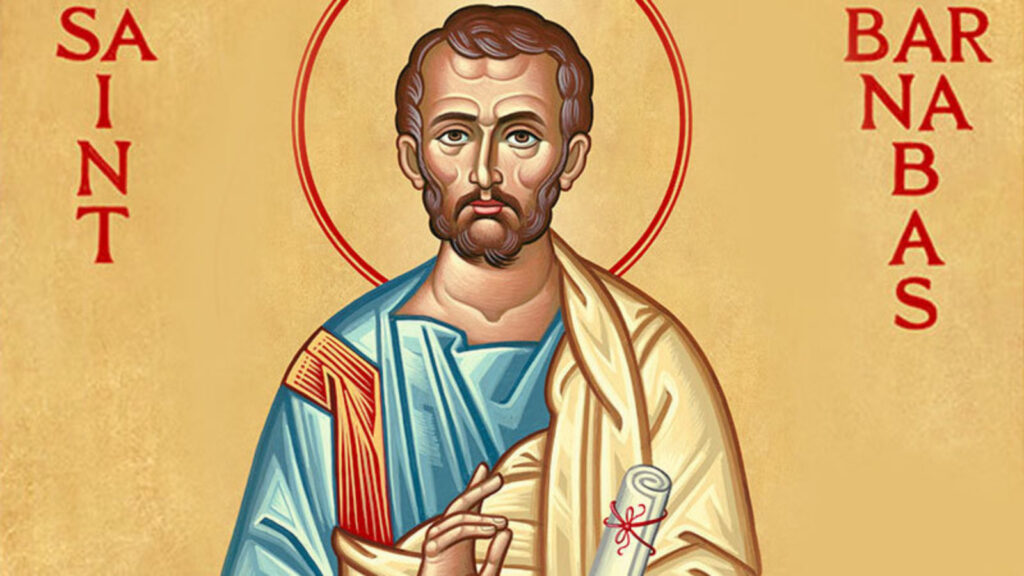
The Apostle Barnabas and the other disciples appear to have lived according to the teachings of Jesus without perceiving them as being in conflict with the existing Jewish law. They did not consider themselves a separate sect, but rather a continuation of an existing prophetic tradition. At the same time, Jesus and his followers were perceived as a threat by certain religious authorities, likely because of the implications his message carried for established structures of authority.
In the Gospel of Barnabas, Jesus states that he did not come to destroy the laws of the prophets, but to observe them (chapter 36). He was often accused of seeking to alter Mosaic law, yet the account presents him as reaffirming its authority and calling for its continued observance. He also speaks directly about the distortion of scripture by those in positions of religious authority: “It is so written, but Moses did not write it, nor Joshua, but rather our rabbis who do not fear God.” (Barnabas, chapter 44)
There is a notable irony in this. The very corruption he is described as confronting is presented as having been repeated after him, by those who claimed to follow him. This concern is echoed in the introduction to Barnabas’ Gospel, which appears to warn explicitly against the alteration of sacred teachings:
“…God hath during these days visited us by his Prophet Jesus Christ in great mercy of teaching and miracles, by reason whereof many, being deceived by Satan, under presence of piety, are preaching most impious doctrine, calling Jesus Son of God, repudiating the circumcision ordained of God forever, and permitting every unclean meat; among whom also Paul hath been deceived, whereof I speak not without grief; for which cause I am writing the truth which I have seen and heard in the intercourse that I have had with Jesus, in order that we may be saved, and not be deceived of Satan and perish in the judgement of God. Therefore beware of every one that preacheth unto you new doctrine contrary to that which I write, that ye may be saved eternally.”
Barnabas’ remains were discovered in 488 AD in the Cypriot town of Salamis, where he is believed to have been martyred. According to some accounts, a handwritten copy of his Gospel was found lying upon his chest, reportedly written in Aramaic, the language spoken by Jesus. If accurate, this detail suggests an awareness of the possibility that the message of Jesus could be altered, and an intention to preserve a direct account of what had been witnessed.
At first glance, Jesus’ affirmation of earlier prophetic law does not appear so controversial as to require concealment. What the Gospel of Barnabas presents beyond this, however, extends further, challenging the theological foundations upon which the Christian Church has been constructed.
According to Barnabas’ account, Jesus was not the Son of God, but a human prophet. He was not the Messiah of earlier prophecies, but one who came to prepare the way for the true Messiah, whom he identifies by name as Muhammad. Jesus refers to Muhammad repeatedly, both by name and by the title “Messenger of God”, often in passages of striking reverence:
“I therefore say to you that the Messenger of God is a splendour that shall give gladness to nearly all that God has made, for he is adorned with the spirit of understanding and of counsel, the spirit of wisdom and might, the spirit of fear and love, the spirit of prudence and temperance, he is adorned with the spirit of charity and mercy, the spirit of justice and piety, the spirit of gentleness and patience, which he has received from God three times more than he has given to all his creatures. O blessed time, when he shall come to the world! Believe me that I have seen him and have done him reverence, even as every prophet has seen him: seeing that of his spirit God gives to him prophecy. And when I saw him, my soul was filled with consolation, saying ‘O Muhammad, God be with you, and may he make me worthy to untie your shoelatchet, for obtaining this I shall be a great prophet and holy one of God’”. (Barnabas, chapter 44)
The Jesus That Remained, and the Jesus That Disappeared
The account of Jesus’ life and prophethood in the Gospel of Barnabas will appear immediately familiar to Muslims, as it closely reflects the portrayal of Jesus found in the Quran. He is presented as one who came to confirm the laws and messages of the previous prophets, as already noted. He does not claim to be the Messiah of earlier prophecies, nor does he present himself as the Son of God. On the contrary, he explicitly warns against such beliefs, saying, “Woe to you if you believe this, for I have won from God a great curse against those who believe this.” (Barnabas, chapter 70)
The Quran mirrors this position in several places. In Surah Al-Ma’idah, it states:
“Those who say, ‘Allah is the Messiah, son of Mary,’ have certainly fallen into disbelief. Jesus ˹himself˺ said, ‘O Children of Israel! Worship Allah — my Lord and your Lord.’ Whoever associates others with Allah ˹in worship˺ will surely be forbidden Paradise by Allah. Their home will be the Fire. And the wrongdoers will have no helpers.” (Quran 5:72)
The Death That Defines the Narrative
It appears, then, that the two most significant omissions correspond precisely with the elements most closely aligned with Islamic teaching. One has already been addressed: that Jesus was not the Messiah, but that he came to prepare the way for the true Messiah, Muhammad, the Messenger of God. The second, perhaps even more consequential, is that Jesus did not die on the cross, but was instead raised into heaven by God, where he remains until his return in the end times. In his place, Judas, the disciple who betrayed him, was made to resemble him and was crucified, deceiving even those closest to him.
In contrast to the narrative presented in the four canonical Gospels, where Jesus is crucified, calls out to God, is buried, and rises three days later, the Gospel of Barnabas offers an account that closely aligns with the Quranic version. Consider the following passages:
“… if men had not called me God, I should have seen God here as he will be seen in Paradise, and should have been safe not to fear the day of judgement…if I had not been called God I should have been carried into Paradise when I will depart from the world, whereas now I shall not go thither until the judgement. Know, O Barnabas, that for this I must have great persecution, and shall be sold by one of my disciples… I am sure that he who shall sell me shall be slain in my name, for that God shall take me up from the earth and shall change the appearance of the traitor so that everyone shall believe him to be me; nevertheless when he dies an evil death, I shall abide in that dishonour for a long time in the world. But when Muhammad shall come, the Sacred Messenger of God, that infamy shall be taken away. And this shall God do because I have confessed the truth of the Messiah who shall give me this reward, that I shall be known to be alive and to be a stranger to that death of infamy.” (Barnabas, chapter 112)
“Behold! Allah said: ‘O Jesus! I will take thee and raise thee to Myself and clear thee (of the falsehoods) of those who blaspheme; I will make those who follow thee superior to those who reject faith, to the Day of Resurrection. Then shall ye all return unto Me, and I will judge between the matters wherein ye dispute.’” (Quran 3:55)
What Happens When Truth Is Not Meant to Circulate
The parallels are difficult to ignore. They return us to the central question: why was this Gospel excluded from the Biblical canon? What, precisely, is there to fear in the coming of another Prophet after Jesus, especially one described as a mercy to all people?
One possible answer lies not only in theology, but in power. A religion presented in its unaltered form, one that calls for submission to God rather than to institutions, produces individuals who are less easily governed. Organised systems rely on structure, hierarchy, and compliance. A message that directs allegiance away from such structures and toward God alone disrupts that balance.
If such a message were widely accessible, the question would not only be what people believe, but who retains authority over them.
This brings us to the account of Fra Marino, a Christian monk during the time of Pope Sixtus V:
“…Fra Marino, tells us that having accidentally met with a writing of Irenaeus (among others), wherein Irenaeus spoke against Paul, alleging, for his authority, the Gospel of St. Barnabas, he became exceeding desirous of finding an existing copy of this Gospel, and that God of His mercy, having made Fra Marino an intimate friend of Pope Sixtus V, (pope, 1585–1590), one day, as they were together in the Pope’s library, his Holiness fell asleep, and the monk, to occupy himself, reaching down for a book to read, the first he laid his hand on proved to be the very Gospel history that he was seeking. Overjoyed at the discovery, he scrupled not to hide his prize discovery in his sleeve; and, on the Pope’s awakening, took leave of him carrying with him that celestial treasure, by reading of which he became a convert to Muhammedanism.”
The claim that a Gospel attributed to Barnabas was present within the Pope’s own library is, in itself, notable. Equally notable is the account of Fra Marino’s conversion. Whether taken as literal history or as a narrative preserved within a particular tradition, the implication remains the same: the text was not entirely unknown, and its contents were capable of altering belief.
It is difficult to imagine that such a development would have served the institutional interests of the Church, particularly if it risked the loss of members of its own clergy.
A Religion Reframed for an Empire
M.A. Yusseff argues that when the Roman Empire moved toward adopting Christianity as its official religion, it required a form that could be broadly accepted and that did not depart too sharply from the religious frameworks already familiar to its populations. Within this context, the story of Jesus could be shaped around a recognisable structure, one that aligned with existing symbolic and mythological patterns.
Yusseff explains that, alongside the idea of an Earth-Mother goddess, there also existed a widespread belief in:
“…the man-god who in fact personified vegetation and its cycle, and often the sun and its cycle. In the case of Osiris, Baal, and Cronus, he also represented a deceased king worshipped as divine. This man-god, when worshipped in association with the sun, was always supposedly born on December 25th so as to correspond with the winter solstice. Forty days later, or around the time of Easter, he had to be slain, laid in a tomb, and resurrected after three days so that his blood could be shed upon the earth in order to maintain or restore its fertility as well as to ensure the salvation of his worshippers. His resurrection was a sign to them that because he gave his life and shed his blood for them and was resurrected from death, they too would be saved from death and thereby enjoy eternal life.”
Seen through this lens, the emergence of a theological framework centred around a “Son of God” who is crucified, whose blood is shed for humanity, and who is resurrected, can be understood as aligning with patterns that were already embedded within earlier religious traditions. This characterisation, however, is not present in the Gospel of Barnabas, nor in the Quranic account of Jesus.
It is necessary, however, to address the objections that are often raised against this line of argument. The most common is the claim that the Gospel of Barnabas is a later forgery, composed after the rise of Islam in order to validate the Quranic narrative of Jesus. It is a serious objection, and one that cannot be dismissed without consideration.
Yet it is complicated by several claims and reports that continue to circulate in historical discussions. As noted earlier, the Gospel of Barnabas has been reported in some accounts to have been recognised within certain early Christian communities prior to 325 AD, whereas the Quran was revealed to the Prophet Muhammad in the seventh century. In addition, reports from 1984 describe a page believed to be from an early manuscript, discovered in a cave near Hakkari in Turkey, which, when analysed, was dated to approximately nineteen centuries ago, placing it roughly within the period in which Barnabas would have lived. The text was said to be written in Aramaic, and when compared with existing English and Arabic translations of the Gospel, it was believed to correspond.
Whether one accepts these reports in full or approaches them with caution, they complicate the assertion that the Gospel of Barnabas is purely a post-Islamic construction, and suggest that the question may not be as settled as it is often presented.
Another argument frequently raised in Christian-Muslim discourse is that Muhammad falls within the category of false prophets warned of by Jesus. Yet in the Gospel of Barnabas, Jesus appears to frame this warning differently:
“As for me, I am now come to the world to prepare the way for the Messenger of God, who shall bring salvation to the world. But beware that you be not deceived, for many false prophets will come, who shall take away my words and contaminate my Gospel.” (Barnabas, chapter 72)
Within this account, the warning is not directed toward the Messenger who is to come, but toward those who would alter the message itself.
The Name That Was Never Meant to Be Clear
Considering the introduction to Barnabas’ Gospel cited earlier, it becomes more plausible within this framework that the false prophets warned of are not those yet to come, but figures such as Paul, the Nicolaitans, and others who are presented as having played a role in altering the message and reshaping the Gospel tradition.
The claim that Jesus prophesied the coming of Muhammad is not confined to the Gospel of Barnabas. For Muslims, this is already an accepted position, as it is explicitly referenced in the Quran. Many Christians, too, will have encountered similar arguments, particularly in discussions surrounding whether such a prophecy can be found within earlier Biblical texts. The more common response, however, is that Jesus was referring not to a future prophet, but to his own return.
In English translations of the New Testament, this is often reflected in the rendering of Jesus’ words as referring to a coming “comforter,” a term later interpreted as referring to himself. Yet the original Greek allows for a broader range of meaning, and the question of interpretation remains open. Consider M.A. Yusseff’s analysis of this Greek excerpt from John’s Gospel, with the alternative meanings provided in parentheses:
“And I will pray the Patera (Nourisher/Sustainer i.e., God), and he shall give you another ‘paraclete’ (Messenger) that he may abide with you forever. The ‘pneuma’ (inspired), the ‘aleuthia’ (truthful), whom the world will not receive or welcome because it will not comprehend or appreciate him, but you who believe will recognise him.”
The English rendering of “Paraclete” as “comforter” narrows a term whose semantic range is wider, often translated as advocate, helper, or one who is called to stand alongside. Some arguments go further, suggesting that “Paraclete” may reflect or have replaced an earlier term such as “Periclyte”, meaning “illustrious” or “praiseworthy”, meanings that are also associated with the name Muhammad.
In Anacalypsis, Sir Godfrey Higgins writes:
“Bishop Marsh has observed that the term ‘Paraclete’ may reflect an earlier Semitic form such as prqlit, preserved in Syriac as parqlīṭā, and later rendered into Greek. If, as he suggests, this term carries the meaning of ‘illustrious’, then rendering it as ‘Paraclete’, and reducing it to ‘comforter’, is not a neutral translation, but a distortion of meaning.”
Whether one accepts this interpretation fully or not, the linguistic and translational questions it raises point to a broader issue: that meaning is not only conveyed through words, but also shaped by how those words are chosen, translated, and preserved.
What Remains Once Certainty Is Disturbed
When considered alongside the uncertainties surrounding authorship, the documented processes of alteration and exclusion, the theological disputes of the early Church, and the notable alignment between the Gospel of Barnabas and the Quranic account of Jesus, a more complex picture begins to emerge. The story of Jesus, as it has been transmitted through institutional channels, is not as singular or uncontested as it is often presented.
The formation of the Biblical canon was neither a simple nor a neutral process. Alternative accounts existed, and their disappearance was not without consequence. Whether the Gospel of Barnabas is understood as authentic history, later composition, or theological intervention, its contents continue to challenge established doctrines and reopen fundamental questions of prophecy, revelation, and authority.
At the very least, they compel a reconsideration of how religious traditions are formed, who determines what is preserved, and what may have been lost in the process. The pursuit of truth, in this sense, requires more than passive inheritance. It demands scrutiny, intellectual honesty, and the willingness to confront what unsettles long-held assumptions. At times, it also requires a leap of faith.
“After Jesus had departed, the disciples scattered through the different parts of Israel and of the world, and the truth, hated of Satan, was persecuted, as it always is, by falsehood. For certain evil men, pretending to be disciples, preached that Jesus died and rose not again. Others preached that he really died but rose again. Others preached, and yet preach, that Jesus is the Son of God, among whom is Paul deceived. But we – as much as I have written – we preach to those that fear God, that they may be saved in the last day of God’s Judgment. Amen.” (Final chapter of Barnabas’ Gospel)
No Comment! Be the first one.