



Was Bahrain Ever Part of Iran?
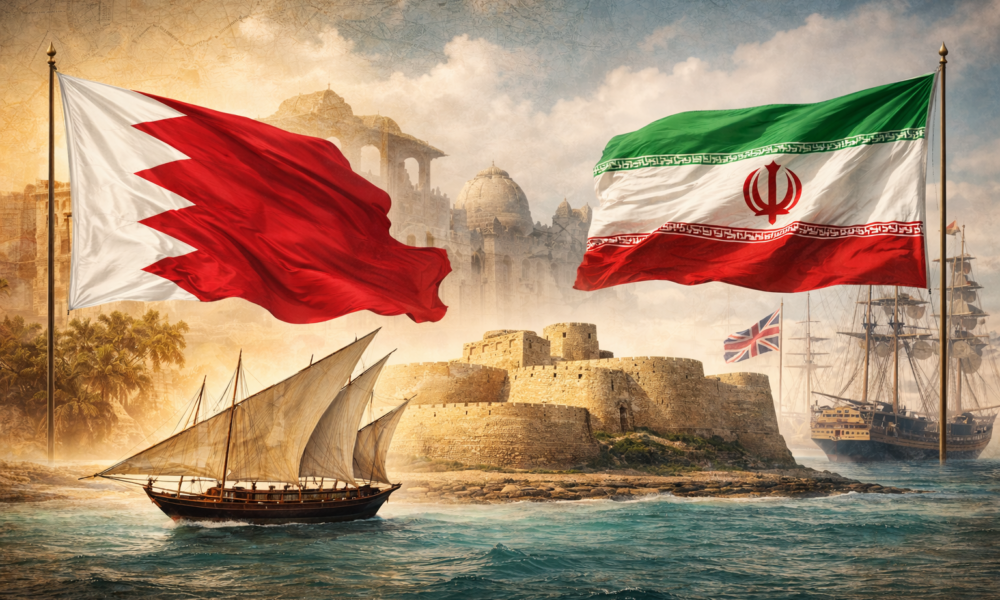
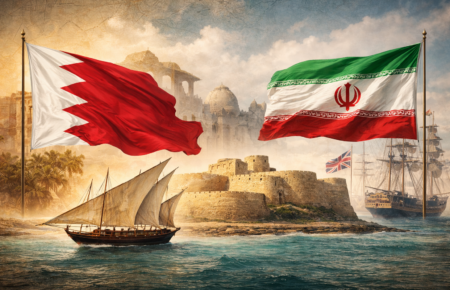
Bahrain’s modern identity is frequently presented as the natural outcome of a continuous and internally coherent past, as though its current political form emerged without disruption from a clearly defined origin. In reality, the history of Bahrain is far less linear. It reflects the repeated repositioning of a strategically significant territory within larger structures of power, shaped first by regional dynamics across Eastern Arabia and Persia, and later by the decisive intervention of empire.
To understand Bahrain as it exists today requires stepping back into a pre-national world, where the islands were part of a wider maritime and coastal environment linking Eastern Arabia, southern Iraq, and Persia into a single, interconnected space. Within that setting, sovereignty was rarely absolute, and political authority shifted between competing powers whose influence overlapped rather than replaced one another.
Bahrain’s trajectory cannot be reduced to a single origin or a single claim because it was formed through layers of control, interaction, and contestation that never fully aligned into a simple or uncontested whole.
Bahrain in the Pre-Modern World
Long before the emergence of modern states and the rigid borders that now define them, Bahrain occupied a position that far exceeded its geographic scale, functioning not as a peripheral island but as a central node within a wider network of exchange that connected some of the most significant civilisations of the ancient world.
From the era of Dilmun, which appears in Mesopotamian records not merely as a distant land but as an essential intermediary, Bahrain facilitated the movement of goods, ideas, and people between Mesopotamia and the Indus Valley. This role as a conduit of interaction established a pattern that would endure across successive historical periods, ensuring that Bahrain remained embedded within regional and transregional systems rather than isolated from them.
What distinguished Bahrain during this early phase was not simply its participation in trade, but the way in which it absorbed and reflected multiple influences at once, developing a layered identity shaped by its position at the intersection of maritime routes and cultural spheres. Its ports were not endpoints, but passages through which merchants, administrators, and travellers moved continuously, carrying with them languages, beliefs, and practices that left lasting imprints on the islands’ social fabric. This constant circulation prevented the formation of a singular, insular identity, instead situating Bahrain within a shared space that extended across what would later be divided into separate political entities.
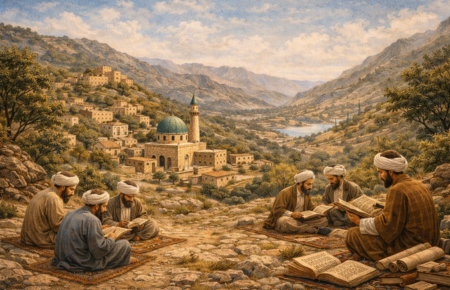
As the region entered the Islamic period, Bahrain’s importance did not diminish but rather evolved, taking on new dimensions that extended beyond commerce into intellectual and religious life. The islands became associated with currents of Shi‘i thought that were closely connected to centres in southern Iraq and Persia, and this association was not incidental but rooted in sustained patterns of exchange and movement. Scholars, jurists, and religious figures travelled between these regions with relative ease, contributing to a network of learning that did not recognise the later boundaries imposed by modern states. Bahrain’s proximity to key centres such as Basra, Najaf, and the Persian heartlands allowed it to participate actively in these developments, reinforcing its position within a broader intellectual landscape.
At the same time, Bahrain remained deeply tied to the Arab populations of Eastern Arabia, with tribal, linguistic, and social connections that anchored it within that sphere as well. This dual orientation, toward both the Persian and Arab worlds, was not a contradiction but a defining feature of Bahrain’s historical character. It existed within a continuum where affiliations overlapped rather than excluded one another, and where political authority could shift without erasing underlying cultural and social linkages.
By the time early modern empires began to consolidate their influence across the region, Bahrain was already situated within a complex and interconnected environment that resisted simple classification. Its history up to that point cannot be understood in terms of fixed identities or exclusive allegiances, but rather as the product of sustained interaction across a shared maritime and coastal world. This context is essential, because it explains why later claims over Bahrain, whether Persian or otherwise, did not emerge in a vacuum but were rooted in a long-standing pattern of integration that had defined the islands for centuries.
Bahrain Within a Persian Imperial Order
The early seventeenth century marked a turning point not simply in who controlled Bahrain, but in how the islands were positioned within a structured imperial system.
When Safavid forces expelled the Portuguese in 1602, they were not acting in isolation, but as part of a broader effort to reassert control over strategic maritime territories that had fallen under European influence. Bahrain’s capture therefore needs to be understood within the wider Safavid objective of securing the coastal and island zones that were essential to both regional authority and economic stability.
Once incorporated, Bahrain was administered through mechanisms consistent with Safavid provincial governance, linking it directly to centres of authority across the Persian mainland. Officials appointed by the state were responsible not only for maintaining order, but also for ensuring the steady flow of revenue, particularly from resources that had long defined Bahrain’s economic value, such as its pearl fisheries. These resources were not peripheral to the Safavid economy; they were integrated into networks of trade that extended beyond the immediate region, reinforcing Bahrain’s role within a larger imperial structure.
At the same time, Safavid rule operated within an environment that required negotiation with existing local realities. The Arab populations of the islands and their connections to Eastern Arabia were not displaced, but incorporated into the administrative and social fabric under Persian oversight. This created a layered system in which imperial authority coexisted with local influence, producing a form of governance that was neither entirely imposed nor entirely autonomous. The result was a political arrangement that maintained continuity with earlier patterns of interaction while embedding Bahrain more firmly within a Persian-controlled framework.
Religious policy under the Safavids further deepened this alignment, not through abrupt transformation, but through sustained reinforcement. The state’s commitment to Twelver Shi‘ism was reflected in its institutions and patronage, strengthening religious ties that linked Bahrain to clerical and scholarly centres across the Persian domain. This dimension of integration carried significance beyond the period of direct rule, as it contributed to a shared religious orientation that would later inform how Bahrain was perceived within Iranian political thought.
What distinguishes this phase is not merely that Bahrain fell under Persian control, but that it was incorporated in a way that bound it to the administrative, economic, and religious systems of a larger empire. Even as Safavid authority weakened in the late seventeenth and early eighteenth centuries, and periods of instability disrupted direct governance, the imprint of this integration did not simply disappear. It persisted in the structures that had been established and in the political memory that would later be invoked when questions of sovereignty over Bahrain resurfaced.
The Eighteenth Century Shift
The events of 1783 did not simply introduce a new ruling family to Bahrain; they reflected a broader reconfiguration of power taking place across Eastern Arabia at the time.
The rise of the Al Khalifa must be understood within the context of shifting tribal alliances, commercial competition, and the gradual weakening of Persian authority in the region following the decline of Safavid power and the instability that followed under subsequent dynasties. Bahrain, in this sense, did not change direction in isolation, but was drawn into a wider pattern in which control over coastal and island territories became increasingly contested among regional actors.
The Al Khalifa’s move into Bahrain was closely tied to their position within the networks of Zubarah and the northern Qatari coast, where trade, pearling, and regional mobility formed the basis of both wealth and influence. Their control over Bahrain therefore represented not just a territorial acquisition, but an extension of an existing economic and political sphere that connected the islands more directly to Eastern Arabia’s tribal-commercial landscape. This alignment brought Bahrain into closer association with Arab power structures, but it did not sever the historical layers that had linked it to Persia.
What is often overlooked in simplified accounts is that this transition did not produce immediate or uncontested stability. Persian attempts to reassert influence did not disappear overnight, and the islands remained exposed to pressures from multiple directions, including Oman and other regional forces seeking to assert their own positions. Authority in Bahrain during this period was therefore not absolute, but negotiated and at times precarious, shaped by a balance that could shift with changing circumstances.
From the Iranian perspective, the events of 1783 did not constitute a definitive loss in legal or historical terms. The earlier incorporation of Bahrain into a Persian imperial framework continued to inform how sovereignty was understood, and the displacement of direct control was viewed less as a permanent settlement than as a disruption of an existing order. This distinction is important, because it explains why Iranian claims would later persist despite the absence of continuous governance on the ground.
At the same time, it would be inaccurate to characterise Bahrain under Al Khalifa rule as an independent state in the modern sense.
The Al Khalifa rulers operated within a regional environment where autonomy was constrained by the need to navigate external threats and alliances, and where the absence of a dominant overarching power created both opportunity and vulnerability. Bahrain’s position during the late eighteenth century was therefore defined less by fixed sovereignty than by its place within a shifting regional system.
Seen in this light, the eighteenth century does not provide a clean break in Bahrain’s history, but rather a transitional phase in which earlier imperial connections were weakened, new regional alignments were formed, and the conditions were set for a more decisive transformation that would emerge with the arrival of British power in the following century.
The British Intervention
The nineteenth century did not introduce British power to Bahrain in a sudden or isolated manner; it marked the gradual consolidation of an external force that had already begun to reshape the political geography of Eastern Arabia and its surrounding maritime sphere.
Britain’s presence in the region was driven less by local concerns than by the imperatives of empire, particularly the need to secure uninterrupted routes to India and to eliminate any possibility of competing influence – whether from regional actors or from other imperial powers. In this context, Bahrain was not an incidental territory, but a strategically valuable point within a wider system that Britain sought to control with increasing precision.
The process through which Britain established its authority in Bahrain unfolded over several decades, beginning with early maritime truces and culminating in a series of agreements that progressively restricted the autonomy of the Al Khalifa rulers. The treaties of the nineteenth century, including those of 1820, 1861, 1880, and 1892, were not merely diplomatic arrangements but instruments of structural control. They placed Bahrain’s external relations firmly under British oversight, preventing the rulers from entering into independent agreements with other powers and effectively closing off avenues through which influence from Persia or elsewhere might re-emerge.
What emerged from this process was not formal colonisation, but a form of indirect rule that was, in many respects, equally decisive. Bahrain retained its local leadership, but its position within the regional order was no longer self-determined. Decisions that carried external implications were shaped, constrained, or outright dictated by British interests, embedding the islands within an imperial framework that extended across the coastal territories of Eastern Arabia.
This transformation had consequences that extended far beyond Bahrain itself.
The region, which had long operated as a space of overlapping influence and shifting authority, was gradually reorganised into a system of defined political units whose boundaries and alignments were stabilised under British supervision. This reordering did not erase earlier connections, but it rendered them increasingly impractical. The historical links between Bahrain and Persia, which had once been sustained through political, economic, and religious channels, were not dismantled in a single act, but were slowly deprived of the conditions that had allowed them to function.
By the late nineteenth century, Bahrain’s separation from Persian authority had become embedded within a structure that was designed to endure. The absence of direct annexation did not diminish the extent of British control; rather, it allowed Britain to maintain influence while avoiding the administrative burdens of formal colonial rule. The result was a political arrangement in which Bahrain’s trajectory was effectively fixed within an imperial system that limited alternative outcomes.
It is within this context that the later persistence of Iranian claims must be understood. Those claims did not arise in a vacuum, nor were they sustained simply out of sentiment. They were responses to a reordering of the region that had excluded Iran from a space in which it had previously exercised authority, and that had done so through mechanisms that were gradual, deliberate, and difficult to reverse.
Iran’s Claim and the Limits of Power
The consolidation of British authority across Eastern Arabia did not bring an end to Iran’s position on Bahrain; rather, it transformed the nature of that position from one rooted in direct governance to one sustained through political memory, legal assertion, and the evolving language of modern statehood.
For Iranian rulers, Bahrain was not simply a distant territory that had slipped out of control, but a place whose earlier incorporation into a Persian imperial order continued to carry meaning within the framework of sovereignty as it was being redefined in the nineteenth and twentieth centuries.
This continuity of claim was not maintained in a static or purely symbolic form. As Iran itself underwent a process of centralisation and modernisation, particularly from the late Qajar period into the Pahlavi era, questions of territory and national integrity became increasingly tied to the project of state formation. In this context, Bahrain assumed a significance that extended beyond its material value. It came to represent the limits of Iranian authority in a region where that authority had been constrained by external intervention, and where the boundaries of the state were being renegotiated in response to both internal reforms and external pressures.
Under the Pahlavi dynasty, these concerns were articulated with greater clarity and institutional backing. The Iranian state moved to formalise its position by incorporating Bahrain into its official administrative discourse, at one point designating it as a province within its national framework. This step was not intended to produce immediate control on the ground, but to assert a legal and political continuity that could not be dismissed as a relic of the past. It reflected an understanding of sovereignty that drew on historical precedent while adapting to the language and expectations of the modern international system.
At the same time, the assertion of such claims was shaped by an awareness of the constraints imposed by the prevailing balance of power.
Britain’s entrenched position in Bahrain and across the wider region limited Iran’s ability to act on its claims in any direct manner. Diplomatic channels, statements of principle, and symbolic acts of incorporation therefore became the primary means through which the claim was sustained. This created a situation in which the question of Bahrain’s status remained active within Iranian political thought, even as the practical conditions necessary for altering that status were absent.
The persistence of this unresolved tension highlights a broader dynamic in the formation of modern states, where historical memory and legal assertion often continue to operate alongside, and sometimes in opposition to, the realities of geopolitical constraint.
In the case of Bahrain, the Iranian claim endured not because it could be enforced, but because it was grounded in a conception of sovereignty that had not been fully reconciled with the regional order imposed during the nineteenth century. The result was a dual reality in which Bahrain existed as part of one political system in practice, while remaining embedded within another in the realm of historical and legal imagination.
Independence Within a Structured Outcome
The resolution of Bahrain’s status did not emerge organically from a neutral process, but from a moment of transition in which Britain’s decision to withdraw from its positions east of Suez forced long-suspended questions into the open.
For decades, the issue of Bahrain’s sovereignty had been contained within an imperial framework that allowed ambiguity to persist without requiring resolution. Once that framework began to dissolve, the underlying tensions that had been managed rather than settled could no longer be deferred.
The mechanism through which this question was addressed was presented in procedural terms, centred on the assessment of the population’s preferences.
A mission was tasked with determining the prevailing sentiment among Bahrain’s inhabitants, and its findings indicated a clear inclination toward the establishment of an independent state rather than incorporation into Iran. Iran, in turn, accepted this outcome, formally relinquishing its claim, and Bahrain entered the international system as a sovereign state in 1971.
While this sequence of events is often framed as a decisive and conclusive settlement, such a reading overlooks the extent to which the conditions shaping that outcome had already been established over a much longer period. The preferences expressed at that moment did not arise independently; they were formed within a political environment that had been structured by decades of local governance under the Al Khalifa and sustained integration into a British-controlled order. The range of viable options, as they were perceived by the population, was itself a product of that historical trajectory.
Moreover, the form that the resolution took reflected the broader logic of the international system at the time, in which questions of sovereignty were increasingly addressed through the language of self-determination, even when the contexts in which such determinations were made had been shaped by earlier asymmetries of power. The outcome in Bahrain therefore aligned with the prevailing norms of that system, but it did not exist independently of the processes that had defined the region throughout the nineteenth and twentieth centuries.
To describe Bahrain’s independence as the simple expression of an inherent or long-standing identity is to overlook the extent to which that identity had been shaped within a specific set of political constraints. At the same time, to reduce the outcome to external imposition alone would ignore the agency of the population whose position ultimately informed the final decision. The reality lies in the intersection of these factors, where historical experience, political structure, and the pressures of a changing international order converged to produce a result that was both contingent and definitive.
In this sense, Bahrain’s independence represents not the beginning of a new and unrelated chapter, but the formal recognition of a state that had already been defined through a prolonged process of transformation. It closed a dispute in legal terms, but it did so by confirming an arrangement that had been shaped over time, rather than by resolving the deeper historical layers from which that dispute had emerged.
Beyond Simplified Narratives
Any attempt to reduce Bahrain’s history to a single claim or a fixed identity ultimately collapses under the weight of the record itself, not because the subject is inherently obscure, but because it has been shaped by overlapping systems of power that do not align neatly with the categories imposed on it today.
The islands have, at different points, existed within a Persian imperial framework, been governed by an Arab ruling order rooted in Eastern Arabia, and been repositioned within a wider structure defined by British strategic interests. None of these phases can be isolated without distorting the others, and none can be dismissed without weakening the coherence of the whole.
What surfaces from this is not ambiguity for its own sake, but a clearer understanding of how sovereignty in this region was historically constructed. Authority was not transferred through a single decisive moment, nor did it pass cleanly from one power to another in a way that erased previous arrangements. Instead, it was layered, contested, and often redefined under conditions shaped by forces that extended well beyond the immediate territory in question.
Bahrain’s incorporation into a Persian imperial order, its subsequent alignment with Arab political structures, and its eventual consolidation within a British-controlled system were not separate episodes, but interconnected stages in a longer process of transformation.
Recognising that Bahrain was once part of a Persian political sphere does not challenge its present status as a sovereign state, just as acknowledging the eventual outcome of independence does not invalidate the historical foundations upon which Iranian claims were built. The difficulty lies not in choosing between these positions, but in accepting that they coexist within the same historical continuum. Each reflects a different moment in the evolution of the islands’ political identity, and each is grounded in a set of conditions that were real in their time, even if they no longer define the present.
The persistence of this issue is not the result of misunderstanding alone, but of the tension between narratives that seek clarity and a history that resists it. Modern frameworks tend to demand definitive answers, yet the past rarely offers them in a form that aligns with contemporary expectations. Bahrain’s history, when examined in its full scope, challenges the assumption that political identity must be singular and continuous, revealing instead a trajectory shaped by interaction, adaptation, and external intervention.
To engage with this history meaningfully is not to resolve the question in favour of one claim over another, but to move beyond the constraints that make such a resolution appear necessary. It requires recognising that the boundaries and affiliations now treated as fixed were the outcome of specific historical processes, many of which were driven by considerations that had little to do with the identities later used to justify them. In doing so, the discussion shifts from asserting certainty to understanding how that certainty was constructed, and why it continues to be defended with such insistence.
References:
- United Nations: Yearbook of the United Nations (1970)
- United Nations Security Council: Resolution 278 (1970)
- Qatar Digital Library: British India Office Records on Bahrain (treaties, correspondence, 19th-20th c.)
- Encyclopaedia Iranica: “Bahrain: Political Relations with Iran”
- The Persian Gulf in History
- Britain and the Persian Gulf, 1795-1880, J.B. Kelly
- The Persian Gulf: A Political and Economic History, Mehran Kamrava
- The Archaeology of Bahrain: Harriet Crawford
- Dilmun and Its Gulf Neighbours: Harriet Crawford
- A History of the Arabian Peninsula
- The Shi‘a of Bahrain: Fuad I. Khuri
- Shi‘ism and Social Protest: Juan Cole
- Safavid Iran: Roger Savory
- The Origins of the Bahrain State
- Tribes and State Formation in Eastern Arabia
- Iran and the Arab World
- The Roots of North-South Conflict in the Gulf
- The United Nations and the Independence of Bahrain
No Comment! Be the first one.