


The Sectarian Machine: Empire’s Architecture of Muslim Division
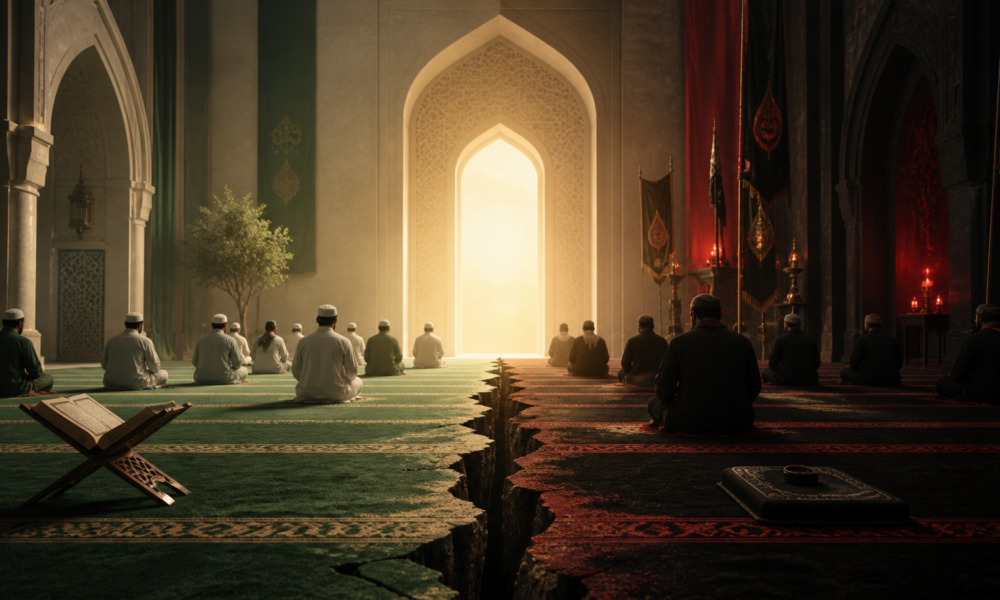
The most dangerous myths are not always imposed from outside. Some become so familiar that even their victims begin to speak through them.
In the modern Middle East, few myths have been more politically useful, more violently repeated, or more lazily accepted than the idea that Muslims are condemned by their own religion to sectarian conflict, as though the region’s wars, betrayals, rivalries, and fractures can all be traced back to an ancient theological wound that never healed.
The explanation survives because it is so simple. It asks extraordinarily little of the audience, and even less of power. It turns history into temperament, politics into creed, and empire into background noise. Iraq is torn apart and called sectarian, Syria is reduced to communal binaries, Yemen is flattened into a proxy war, and Lebanon is treated as a confessional puzzle. The implication is made to feel obvious: these people were always divided, and the modern world merely inherited their ancient hatreds.
Islam is not a tradition without disagreement, nor has its history ever been free of conflict. The early Muslim community faced political disputes, theological disagreements, dynastic rivalries, civil wars, and competing claims to authority. Sunni and Shia traditions did not emerge from nowhere, and their differences are neither imaginary nor insignificant. But the existence of difference is not the same as the organisation of society around sectarian hostility. A theological distinction does not automatically become a governing system, a media language, a security doctrine, or a justification for war. Something has to convert religious identity into political weaponry.
The paradox is sharp because Islam itself contains a powerful moral vocabulary against fragmentation. The Qur’an commands believers to hold firmly together to the rope of Allah and not be divided. It describes believers as a brotherhood and makes reconciliation an obligation when conflict emerges. These are not marginal ethical suggestions; they sit near the centre of Islam’s moral imagination, where communal life is not meant to be organised through inherited enmity, suspicion, or hatred, but through responsibility before God and responsibility towards one another.
This does not mean Islam erases difference. Muslim intellectual life has long contained multiple schools, traditions, juristic methods, theological lineages, and devotional worlds. The ummah was never meant to be a flat, identical mass. It was meant to hold difference without allowing difference to become a weapon of humiliation, excommunication, bloodshed, and political captivity.
The danger begins when disagreement stops being treated as a matter of knowledge, jurisprudence, authority, or historical memory, and becomes instead a system for sorting Muslims into permanent enemies. That is when sectarianism becomes more than prejudice. It becomes a political method: converting religious identity into suspicion, suspicion into fear, fear into obedience, and obedience into a structure that serves those who benefit from Muslim fragmentation.
The real question is not whether Muslims have differed, because they have. The question is why certain differences become politically dominant at certain historical moments, why sectarian identity intensifies during geopolitical crises, and why conflicts over land, power, sovereignty, resources, colonial borders, occupation, and regional influence are so often translated into the language of religious division. A war does not become “Sunni versus Shia” merely because Sunni and Shia actors exist within it. An alliance does not become theological simply because its members belong to different sectarian communities. The label is never innocent because it teaches blame where to land.
Even the word “sectarianism” has to be handled with suspicion. It is often used as if it describes an ancient emotional condition, when in reality it names something far wider and more deliberate: the conversion of religious difference into social hierarchy, state policy, media narrative, security doctrine, and geopolitical suspicion. The word becomes dangerous when it stops describing a problem and starts hiding the forces that manufacture it.
The Middle East has not simply suffered from sectarian difference. It has suffered from the repeated conversion of difference into political architecture. Communities were classified, governed, mobilised, narrated, funded, disciplined, and set against one another until identity became more than belonging. It became a way of distributing fear, legitimacy, suspicion, and power.
To call this merely a Sunni-Shia divide is to begin from the wrong place. The divide exists, but it does not explain itself. Nor does it explain why sectarian rhetoric rises and falls according to political need, why it becomes louder when certain states are threatened, why it is amplified when anti-imperial and anti-Zionist forces disturb the regional order, or why the same actors who claim to fear sectarianism so often benefit from the narratives that deepen it.
The real story is not that Muslims disagreed and therefore the region collapsed into sectarian conflict. The real story is that disagreement was organised, managed, funded, narrated, and weaponised until it became one of the governing grammars of the modern Middle East. Sectarianism is not the inevitable outcome of Islamic history. It is what happens when theological difference is dragged into the service of empire, state power, media manufacture, and geopolitical containment.
The starting point, then, is refusal: refusal of the myth that Islam’s internal differences alone explain the region’s fragmentation, and refusal of the lie that Muslims are naturally condemned to see one another as permanent civilisational enemies.
The answer does not lie in Islam alone, but in the systems that learned how to turn Islam’s internal differences into one of the most effective technologies of fragmentation in the modern region.
The Historical Sunni-Shia Divide
To expose how sectarianism was engineered, we must first be clear about what was not engineered.
Sunni and Shia difference did not begin as a colonial invention, nor can it be dismissed as a modern fabrication. Its origins lie in the earliest and most consequential political crisis faced by the Muslim community after the death of the Prophet Muhammad (pbuh): who had the rightful authority to lead the ummah after him?
That question was never merely administrative. It carried within it deeper concerns about legitimacy, divine guidance, communal consensus, loyalty to the Prophet’s household, and the moral character of leadership. For those who would become identified with the Sunni tradition, the legitimacy of the early caliphs came to rest upon communal recognition, political continuity, and the authority transmitted through the Prophet’s companions. For those who would become identified with the Shia tradition, rightful leadership belonged to Imam Ali ibn Abi Talib and the Ahl al Bayt, not simply as a matter of familial closeness, but as a question of divinely guided authority.
Over time, this early dispute widened into distinct religious traditions. Shia thought developed around the authority of the Imams, the spiritual and moral centrality of the Ahl al Bayt, and the memory of injustice suffered by the Prophet’s family. Karbala did not remain a historical episode. It became a moral universe through which tyranny, sacrifice, legitimacy, loyalty, betrayal, and resistance could be understood.
Sunni traditions, meanwhile, developed around the authority of the Qur’an and Sunnah as transmitted through the broader community of companions, jurists, scholars, and legal schools. These were not shallow differences. They shaped ritual life, jurisprudence, theology, communal memory, and political imagination. But modern sectarian narratives abuse this history. They take real disagreement and stretch it into a false destiny. They imply that because Sunni and Shia traditions emerged from a foundational dispute, Muslim history must therefore be read as one long sectarian war. That is where history is turned into mythology.
Difference existed, polemics existed, and persecution existed. There were periods of brutal sectarian violence, and no serious account should pretend otherwise. But for much of Islamic history, political life was not organised through a simple Sunni versus Shia binary. Dynastic ambition, imperial competition, tribal alliances, urban rivalries, economic interests, class formation, scholarly patronage, military power, and regional loyalties often shaped political conflict more decisively than sectarian identity alone.
The myth of eternal sectarian hatred imagines Sunni and Shia communities as two sealed civilisations locked into permanent hostility from the seventh century until today. It is the story repeatedly invoked whenever the region needs to be explained without examining empire, occupation, dictatorship, resource politics, foreign intervention, state collapse, or Zionist penetration. It is convenient because it makes modern violence appear inevitable. It turns political decisions into inherited destiny, but history refuses that simplicity.
In many pre-modern Muslim societies, sectarian identities existed inside shared social, commercial, intellectual, and political worlds. Baghdad, Damascus, Cairo, and Isfahan were not utopias of harmony, and they should not be romanticised as such. They were cities of power, hierarchy, inequality, scholarship, trade, patronage, debate, and sometimes violence. Yet they were also spaces where different Muslim communities, and often non-Muslim communities too, lived within overlapping civic and imperial structures. A person was not defined only by sect. They were also defined by profession, family, neighbourhood, class, scholarly affiliation, patronage networks, language, region, and relationship to ruling power.
Coexistence should not be confused with equality. Conflict should not be confused with permanent civilisational war. Pre-modern cities could contain polemic, rivalry, and persecution while still depending on everyday forms of shared life. A market, court, school, shrine, trade route, military unit, or neighbourhood could bring people into contact in ways that sectarian shorthand cannot capture. The social fabric was not innocent, but it was thicker than the rigid identity maps imposed on the region later.
Later imperial rivalries would sometimes sharpen these divisions and give them political force, but even then, sectarian identity did not operate in isolation. It moved through dynastic ambition, territorial competition, scholarly authority, military strategy, and state legitimacy. That history matters, but it does not support the myth that Sunni and Shia communities have always existed as two fixed political camps.
This pattern recurs across Islamic history. Sectarian identity could become politically charged when rulers found it useful, when empires competed for legitimacy, or when communities were positioned against one another through state power. But it was not always the default explanation for political behaviour. A Sunni ruler could ally with Shias when it served strategic interests. Shia communities could live under Sunni rule without every political relationship being reducible to theological war. Sunni communities themselves were divided by school, region, class, empire, and ideology. Shia communities were never politically uniform either. The neat binary collapses the moment history is examined closely.
The phrase “Sunni-Shia conflict” often conceals more than it reveals. It suggests that religious identity itself is the engine of history, when more often it has been one language through which power expresses itself. It turns political conflict into inherited theology and then treats the consequences as proof of the premise. If a war involves Sunnis and Shias, it is called sectarian. If foreign powers arm one side, redraw institutions, destroy state structures, or amplify propaganda, these forces become secondary. The label performs the work of analysis without actually analysing anything.
The Sunni-Shia divide is real and historically deep. It cannot be wished away, sentimentalised, or dismissed as a mere misunderstanding. But the modern sectarian order, in which entire conflicts are narrated through fixed religious blocs, is not the natural or inevitable result of that divide. It is the result of later historical processes that turned difference into political infrastructure.
Sunni and Shia Islam developed as distinct traditions because early Muslims disagreed over authority, succession, and the meaning of legitimate guidance after the Prophet (pbuh). Modern sectarianism is something else. It is the conversion of those differences into a political technology. It is not the existence of theological disagreement that requires investigation, but the machinery that taught states, media institutions, colonial administrators, policy experts, clerics, regimes, and ordinary people to interpret the region’s struggles through sectarian reflex before anything else.
The historical divide matters, but it does not explain the modern Middle East on its own. To pretend otherwise is not knowledge, but the first step in allowing power to hide behind religion.
Sectarianism Before Colonial Intervention
Before colonial rule turned communal identity into a modern instrument of administration, Muslim societies had already lived for centuries with religious differences. Sunnis and Shias did not suddenly discover one another under European occupation. Nor did Christians, Jews, Druze, Alawites, Zaydis, Ismailis, Sufis, jurists, tribal confederations, urban notables, merchants, soldiers, and scholars exist outside politics until empire arrived to corrupt them. Difference was not new. What changed was the political function assigned to difference.
Pre-colonial Muslim societies were not innocent of hierarchy, coercion, persecution, or violence. They were imperial societies, and empires govern through ranking, patronage, taxation, law, military power, negotiated submission, and force.
Communities were not treated equally, and moments of coexistence could live beside moments of repression. But the basic organisation of political life was not reducible to the sectarian categories that dominate modern commentary. Power moved through dynasty, court, region, army, tax, trade, land, tribe, legal school, scholarly network, and imperial frontier. Religious identity mattered, sometimes profoundly, but it did not always operate as the master code through which every political relationship was interpreted.
The Ottoman Empire shows this complexity clearly. It governed an enormous and diverse population across Arab, Turkish, Balkan, Kurdish, Armenian, Greek, and other worlds. Its management of religious communities was hierarchical and shaped by Muslim imperial supremacy, but it also allowed recognised communities a degree of legal, communal, and institutional life under their own authorities. This was not liberal pluralism, nor should it be romanticised as equality before the state. It was imperial management. Yet its durability depended on absorbing difference into a layered political order rather than permanently inflaming it into total social rupture.
The Safavid-Ottoman rivalry is often used to flatten this history into a story of timeless Sunni-Shia hostility. The rivalry did reinforce sectarian boundaries in serious ways. The Safavid adoption of Twelver Shiism as a state religion in Iran reshaped the religious geography of the region and gave Shi‘i identity a powerful imperial centre. The Ottomans, claiming Sunni legitimacy and confronting Safavid power on their eastern frontier, responded militarily, politically, and ideologically. Sectarian language became entangled with sovereignty, dynastic legitimacy, and frontier security.
Yet even here, religion did not operate alone. The Ottomans and Safavids were not merely two confessions fighting because theology demanded it. They were empires competing over territory, trade routes, populations, legitimacy, military control, and regional influence. Baghdad, eastern Anatolia, the Caucasus, and the Persianate world were not abstract sectarian symbols. They were strategic spaces. The Treaty of Amasya in 1555, which formalised a frontier after decades of war, shows that even sharpened sectarian rivalry could be negotiated through statecraft when neither empire could eliminate the other.
Sectarian hostility existed, but it moved within the logic of power, not outside it. That is the part modern narratives deliberately strip away. If sectarian hatred were the timeless engine of Middle Eastern history, political alliances would have followed sectarian lines with mechanical consistency. They did not. Rulers often acted according to survival, expansion, economic interest, legitimacy, and balance of power. Communities adapted to the realities of rule. Scholars debated, denounced, transmitted knowledge, and moved through shared intellectual geographies. Cities could contain hostility and coexistence at the same time. Sectarian polemic did not automatically become social totality.
Baghdad, Damascus, Cairo, and Isfahan were not symbols of perfect harmony. They were centres of imperial ambition, scholarly rivalry, commercial exchange, devotional life, patronage, and political contest. A city could host fierce doctrinal debate while still depending on everyday forms of shared life. It could contain sectarian tension without being governed entirely by sectarian logic.
Neighbourhood, profession, court access, economic position, scholarly affiliation, trade, and local authority often shaped life as much as formal religious identity. Pre-modern cities were not peaceful myths. They were dense political worlds that sectarian shorthand cannot explain.
The deeper pattern is that sectarian identity became most politically charged when rulers or empires found it useful for legitimacy, consolidation, or control. Safavid rulers used Shiism to build a new imperial identity in Iran. Ottoman rulers used Sunni legitimacy to strengthen their claims against rivals. Local elites could mobilise communal belonging for protection, influence, or advantage. But this was still not the same as the modern sectarian order. Identity had not yet been standardised through colonial censuses, mandate constitutions, political quotas, externally managed state formation, mass media infrastructures, security doctrines, and international policy language. It had not yet been turned into the default lens through which the region itself would be read.
The modern sectarian imagination does something more violent. It takes fluid, overlapping, historically contingent identities and freezes them into blocs. It teaches people to see political actors first as sectarian representatives, then as anything else. It makes the community appear older and more natural than the state, the class, the empire, the party, the occupation, or the foreign patron. Once history is flattened in this way, modern power becomes harder to see.
Empire has always preferred that lie because it cleans its hands. If Muslims are imagined as naturally sectarian, then invasion becomes intervention, occupation becomes management, and the destruction of political life can be blamed on the people whose world was broken. Local regimes can justify repression by warning of sectarian chaos. Media outlets can reduce wars to Sunni-Shia conflict while leaving out sanctions, military occupation, dictatorship, arms flows, foreign patronage, Zionist strategy, and geopolitical competition. The past becomes a weapon because it has been stripped of its complexity.
The pre-colonial record does not absolve Muslim societies of their own conflicts, nor does it deny the seriousness of Sunni-Shia difference. It shows something more politically useful: sectarian identity existed within broader worlds of power. It could intensify, fade, be mobilised, be contained, be exploited, or be overridden by other loyalties. It was part of history, not the whole of it.
That is what makes the modern order so revealing. Modern sectarianism did not emerge because ancient Muslims disagreed and nothing changed for fourteen centuries. It emerged because inherited differences were repeatedly reorganised by empire, state formation, war, media, and foreign patronage until they became one of the most effective languages of political fragmentation in the region.
The pre-colonial past was not pure. But it was not the modern sectarian order either.
Colonial Engineering of Division
Colonialism did not arrive in the Middle East as a neutral administrator of old conflicts. It arrived as conquest, and conquest always needs a story that makes itself appear necessary. To rule the region, European power had to describe the people it ruled as too divided to govern themselves, too trapped in communal loyalties to build political life, too irrationally attached to religion to be trusted with sovereignty. Once that story was accepted, domination could dress itself as management, intervention as order, and political theft as tutelage.
The lie was never that difference existed. Of course it did. The lie was that difference was destiny.
European colonial powers did not invent every religious, sectarian, ethnic, or regional division they encountered. Their method was more insidious. They entered societies with layered identities and turned those identities into the grammar of administration. They classified populations, empowered selected elites, drew borders, built institutions, wrote constitutions, managed representation, and taught communities that access to power would increasingly pass through communal identity. What had once been one part of social life became, under colonial rule, a political gate.
In Iraq, British rule did not simply inherit a state. It manufactured one. The new Iraq was assembled from the former Ottoman provinces of Basra, Baghdad, and Mosul, territories with distinct histories, social compositions, tribal landscapes, urban centres, religious authorities, and regional orientations. Britain then imposed a mandate structure that wrapped imperial interest in the language of preparation for self-rule. The fiction was sovereignty. The reality was a state built under foreign command, designed to protect strategic routes, oil interests, military access, and imperial prestige.
The British understood that direct rule would be expensive and unstable, especially after the 1920 revolt exposed the depth of Iraqi opposition to foreign domination. So they adjusted the form without surrendering the substance. They built an indirect system that depended on local intermediaries, landed elites, tribal sheikhs, former Ottoman officers, bureaucrats, and a monarchy installed under British patronage. In 1921, Britain placed Faisal ibn Hussein, the Hashemite son of Sharif Hussein of Mecca and former short-lived king of Syria, on the Iraqi throne. He was not chosen because Iraq had organically produced a national consensus around him. He was useful because Britain needed an Arab face for a British-designed order.
This did not simply create a ruling class. It created a political imbalance with long consequences. The new state relied heavily on Sunni Arab officers and administrators who had inherited Ottoman state experience, while many Shia religious authorities and communities, especially after their role in anti-British mobilisation, were treated with suspicion. Kurdish demands were managed separately. Tribal authority was manipulated. Rural society was tied to a state structure that did not emerge from genuine popular sovereignty. The result was not national integration. It was imperial consolidation under the appearance of national government.
Britain’s method was not crude division alone. It was selective elevation. By deciding which elites were useful, which clerics were dangerous, which communities were governable, and which claims could be postponed, Britain helped convert social difference into political hierarchy. The mandate state did not simply reflect Iraq’s internal composition. It reordered it. It made certain forms of belonging more politically profitable than others and left behind institutions carrying the memory of that uneven birth.
Lebanon followed a different path, but the colonial logic was recognisable. Under French rule, communal identity was not merely acknowledged. It was written into the political architecture of the state. France did not approach Lebanon as a society to be freed into sovereignty. It approached it as a landscape of confessions to be balanced, managed, patronised, and contained. The creation of Greater Lebanon in 1920, carved from Ottoman Syrian lands and placed under French mandate, brought together communities with competing political visions, economic interests, and regional orientations. Instead of building a political order capable of transcending those divisions, France entrenched them as the basis of representation.
The 1926 Lebanese Constitution emerged under the French Mandate, and the confessional logic was planted into the state’s operating system. Later arrangements would alter ratios, conventions, offices, and balances, but the deeper principle had already been normalised: political belonging would be mediated through sect. A citizen would be made legible first as Maronite, Sunni, Shia, Druze, Greek Orthodox, Armenian, or another recognised community, and only after that as a political subject.
This is the violence of confessionalism. It does not simply recognise communities. It traps them. It tells people that their political future must pass through sectarian brokers. It turns representation into captivity. Class anger, anti-colonial struggle, labour demands, economic grievances, and popular sovereignty are pushed through communal channels until the system can absorb them without transforming itself. France did not invent Lebanon’s communal diversity. It converted that diversity into a durable structure of rule.
Syria reveals the same imperial instinct through another design. The French Mandate fragmented the territory into separate political units, including Damascus, Aleppo, the Alawite State, Jabal Druze, and Greater Lebanon. This was not innocent decentralisation. It was a colonial map of suspicion. France treated society as a series of manageable regions and communities, each positioned against the possibility of a unified anti-colonial movement. The fear was not sectarianism. The fear was unity.
Colonial “minority protection” must be read through that logic. Empire has always loved the language of protection because it allows domination to present itself as moral responsibility. In practice, the protection of minorities often meant their incorporation into colonial security structures, their isolation from broader national movements, or their use as a counterweight against majoritarian politics. Communities with real vulnerabilities were folded into an imperial strategy that did not liberate them. It made them useful.
The same pattern appears across colonial governance: classify the population, elevate selected intermediaries, encourage communal leadership, reward loyalty, punish resistance, and then present the resulting fragmentation as proof that foreign control is necessary. The coloniser wounds the body, studies the wound, names the wound as native pathology, and then claims authority as the only surgeon available.
“Divide and rule” should not be treated as a slogan. It was a method. It operated through paperwork as much as violence: censuses, legal codes, school systems, police recruitment, land policy, electoral arrangements, personal status law, constitutional design, and administrative classification. Colonialism did not only dominate territory. It produced categories through which people would be governed and eventually taught to govern themselves against one another.
The administrative category is one of empire’s most underrated weapons. Once a community is counted, separated, represented, and negotiated with as a fixed bloc, politics begins to reorganise around that bloc. Leaders emerge whose authority depends on speaking in the name of the community. Resources are distributed through communal channels. Fear becomes political currency. Any attempt to escape the category is treated as betrayal, naivety, or threat. The category becomes more than a description. It becomes a cage.
This was the colonial achievement: not the creation of sectarian feeling, but the institutionalisation of sectarian consequence.
By the time formal mandates ended, the damage had already been built into political life. Iraq inherited a state shaped through British priorities, selective elite incorporation, and uneven access to power. Lebanon inherited a confessional order that made sectarian representation the operating system of politics. Syria inherited a legacy of territorial fragmentation and minority management that would continue to haunt the relationship between state, army, community, and power. Across the region, colonial rule left behind more than borders. It left behind political reflexes.
Those reflexes endure because they are useful. A sectarian system does not merely divide society horizontally. It protects ruling classes vertically. It allows elites to speak in the name of communities while negotiating power among themselves. It turns popular anger away from those who own, govern, exploit, and collaborate, and redirects it towards neighbouring communities whose people are often suffering under the same structures. Sectarianism is not only a weapon against unity. It is a weapon against class consciousness, anti-colonial clarity, and revolutionary possibility.
The colonial order understood something that remains true today: a fragmented people is easier to rule, easier to discipline, easier to bargain with, and easier to betray. When every grievance is translated into communal fear, the real authors of dispossession disappear from view. Empire becomes background, capital becomes invisible, and Zionism becomes a regional “security issue” rather than a settler-colonial project. Reactionary regimes become protectors of sects rather than jailers of their people. Resistance becomes “proxy activity” rather than political defiance.
Colonial engineering was not an episode buried in the mandate period. It became a template. Later regimes, foreign powers, media networks, and policy institutions would inherit and update it. They would learn that sectarian identity could be activated when legitimacy was weak, when occupation needed justification, when resistance had to be delegitimised, when alliances with Zionism had to be disguised, or when economic collapse needed a communal scapegoat.
What colonialism built was not simply division. It built a political technology that could outlive colonial flags. It taught the region to inherit itself through categories designed by its rulers, and it taught the world to mistake those categories for truth.
The Cold War and the Politicisation of Sectarian Identity
The colonial period gave sectarian identity administrative weight. The Cold War gave it strategic use.
By the middle of the twentieth century, the Middle East was no longer only a region of post-Ottoman borders, mandate legacies, monarchies, republics, oil concessions, and anti-colonial movements. It had become one of the central theatres of global rivalry. Washington and Moscow were not simply competing over ideology in the abstract. They were competing over oil, military access, ports, political loyalties, revolutionary movements, Arab nationalism, labour agitation, and the future of states that had only recently emerged from direct European domination.
In that struggle, religion was not treated by Western power as sacred truth or civilisational inheritance. It was treated as a tool.
This is one of the least honestly told chapters of modern Middle Eastern history. The West did not merely “observe” political Islam, nor did it innocently discover religious identity as a social force. It repeatedly found use in conservative religious currents that could be mobilised against communism, socialism, Arab nationalism, and revolutionary anti-imperial movements. Saudi Arabia became central to this arrangement because it offered exactly what US power needed: oil wealth, anti-communist politics, religious legitimacy, and a ruling order deeply invested in preventing revolutionary contagion.
The Cold War therefore did not merely militarise the region. It moralised political loyalty. To be aligned with the West and its Gulf partners was to be framed as a defender of order, tradition, religion, and stability. To oppose them, especially through leftist, nationalist, or revolutionary Islamic politics, was to be marked as subversive, extremist, godless, foreign, or destabilising. The labels shifted according to need, but the logic remained consistent: any politics that threatened imperial access, comprador regimes, or Zionist security had to be made ideologically illegitimate.
Sectarian identity became especially useful inside this structure because it allowed political conflict to be religiously coded without being honestly explained. A revolutionary movement could be dismissed not as anti-imperial, but as sectarian. A resistance alliance could be stripped of its anti-Zionist meaning and reframed as an Iranian project. A regional uprising could be emptied of its social demands and narrated as communal agitation. The more this language circulated, the more it trained people to interpret political struggle through inherited suspicion rather than material power.
The 1979 Islamic Revolution in Iran intensified this entire process because it shattered the regional order that had served the US and its allies. Before the revolution, Iran under the Shah was a pillar of US strategy in the Gulf. Alongside Saudi Arabia, it helped anchor a regional security arrangement favourable to Western interests. The revolution did not simply replace one government with another. It removed a loyal imperial client, introduced an explicitly anti-American and anti-Zionist political language into state power, and claimed Islamic legitimacy outside the authority of the Gulf monarchies.
For the monarchies of the Gulf, the threat was not simply that Iran was Shia. That was the sectarian alibi. The deeper threat was that Iran had shown a Muslim-majority society overthrowing a Western-backed monarch and declaring that Islam could be mobilised against imperial domination rather than in service of palace legitimacy. This was intolerable to regimes whose survival depended on inherited rule, US protection, oil wealth, and the containment of popular politics. Sectarian language became a way to avoid naming the more dangerous fact: they feared revolutionary Islam as a challenge to the entire architecture of dependent rule.
The post-1979 backlash was not spontaneous Sunni anxiety. It was cultivated, funded, narrated, and exported. Saudi Arabia and allied institutions invested heavily in religious infrastructures that promoted particular interpretations of Islam while marginalising or demonising others. Mosques, charities, publishing networks, schools, scholarship programmes, preachers, and transnational religious organisations became channels through which a supposedly apolitical orthodoxy could be spread, while anti-imperial and Shia-inflected political currents were marked as deviant, dangerous, or foreign. The aim was not merely theological persuasion. It was geopolitical discipline.
The Afghan jihad accelerated this architecture. In Afghanistan, the United States, Saudi Arabia, Pakistan, and allied networks found a battlefield where anti-communist mobilisation could be wrapped in Islamic language at massive scale. The objective was not Muslim liberation in any principled sense. It was to bleed Soviet power, expand influence, and cultivate a militant anti-communist front that served the strategic interests of the United States and its partners.
This period gave reactionary religious politics global reach. It created networks, habits, funding channels, recruitment methods, clerical circuits, and ideological reflexes that outlived the Cold War itself. Anti-communism had provided the first justification, but after the Soviet collapse the same infrastructures could be redirected towards new enemies: Iran, Shia political movements, resistance factions, Arab nationalist remnants, Muslim Brotherhood rivals, secular opposition, and anyone who threatened the legitimacy of US-aligned order. The weapon did not disappear; it simply adapted.
Sectarian rhetoric became one of its most efficient forms because it condensed complex political realities into emotionally charged identity categories. Iran was no longer approached as the revolutionary state that had broken from American command and placed anti-Zionism at the centre of its regional posture. It became “Shia expansion.” Hezbollah was not first placed in the history of Israeli occupation and Lebanese dispossession. It became an “Iranian proxy.” Palestinian factions that accepted Iranian support could be treated with suspicion, even when their struggle was plainly anti-colonial and directed against Zionist occupation. Yemen could be explained through Iranian interference while the violence of blockade, bombing, starvation, and Western-backed regional war was pushed to the edge of the frame. This was not accidental language but a deliberate act of containment.
The phrase “Iranian expansionism” became especially useful because it allowed Western, Gulf, and Zionist narratives to merge. For Washington, it justified sanctions, military bases, arms sales, naval presence, and the permanent securitisation of the Gulf. For Gulf monarchies, it justified repression at home, hostility towards Shia populations, regional intervention, and closer security coordination with the United States. For Zionism, it helped recast the region’s central colonial wound as a secondary issue, displaced by the manufactured panic of an Iranian threat. Palestine could be pushed aside, resistance could be sectarianised, and collaboration with Israel could be dressed up as strategic necessity.
The so-called Saudi-Iranian rivalry is often described as a regional cold war, but even that framing can become misleading when it treats the two sides as symmetrical powers floating above history. Saudi Arabia was not merely one pole in a neutral rivalry. It was, and remains, a US-backed monarchy whose ideological exports and security policies were embedded in a wider imperial order. Iran became the object of containment not because of sect alone, but because its revolution disrupted the architecture that had made the Gulf safe for American power.
This geopolitical struggle did not remain in palaces, embassies, and intelligence files. It entered newspapers, satellite channels, religious programming, Friday sermons, school curricula, policy language, and eventually social media. “Safavid” became an insult. “Rafidhi” circulated as a marker of exclusion. “Persian project” and “Shia crescent” became political clichés. “Proxy” became the preferred word for any resistance actor whose alliances disturbed the Western and Zionist map of the region. These terms did not merely describe reality, but served as tools that trained people to feel before they thought.
That emotional training is central to sectarian politics. It teaches the Sunni viewer that Iran is not a state to be analysed but a civilisational danger to be feared. It teaches the Shia viewer that regional hostility is not only political but existential. It teaches Arab publics that Palestine can be loved in poetry while resistance to Israel is distrusted in practice if it passes through Tehran, Beirut, Sana’a, Baghdad, or Damascus. It teaches Muslims to misrecognise the hand that arms their oppressors and fear instead the neighbour whose grief resembles their own.
Cold War sectarianisation also protected authoritarian regimes from accountability. A monarchy could crush dissent and call it the defence of stability. A republic could securitise communities and call it national unity. A state could fail economically, repress politically, collaborate with the West, normalise with Zionism, and still redirect anger towards an internal sectarian enemy. Once political opposition is translated into communal threat, repression no longer needs to defend itself as repression. It becomes protection.
The post-1979 order cannot be understood through theology alone. The revolutionary challenge from Iran, the Saudi project of religious counter-mobilisation, the US need for Gulf stability, the Afghan jihad, the rise of transnational ideological funding, and the media reproduction of sectarian threat all worked together to make sectarian identity geopolitically useful. Sectarianism was no longer only a colonial inheritance or a social prejudice. It became a regional operating system.
The Cold War taught empire and its allies that Islam could be weaponised against revolution. The Islamic Revolution taught them that Islam could also become revolutionary. Everything that followed, from ideological funding to media panic, from anti-Shia incitement to the sectarian framing of resistance, was shaped by the terror of that possibility. The result was not an ancient divide resurfacing. It was a modern political project learning how to survive.
The Iraq War and the Institutionalisation of Sectarian Politics
If colonialism built the categories, and the Cold War weaponised them, Iraq after 2003 turned them into the operating system of a shattered state.
The US-led invasion did not simply remove Saddam Hussein. It broke Iraq open. It dismantled state institutions, humiliated an already exhausted society, destroyed the remaining structures of national administration, and then claimed to be building democracy from the wreckage it had created. The language was liberation, the method was occupation, and the result was a political order in which Iraqis were increasingly recognised, represented, rewarded, and endangered through ethno-sectarian identity.
Iraq did not collapse into sectarian violence because Iraqis suddenly remembered they were Sunni, Shia, Kurdish, Turkmen, Christian, Yazidi, or otherwise. Those identities had long existed. They carried histories of grievance, pride, persecution, belonging, memory, and political exclusion. But identities do not automatically become militias, death lists, ministry quotas, checkpoints, cleansing campaigns, and state capture. Something has to convert them into instruments of survival.
The occupation did that work. From its first months, the Coalition Provisional Authority (CPA) ruled Iraq not as a passive supervisor of transition, but as the sovereign force shaping the new order. It issued orders, controlled institutions, managed state assets, restructured political life, and decided who would be included or excluded from the future being built under occupation. The language of “transition” concealed the deeper reality: Iraq’s political architecture was being rebuilt by the same power that had invaded it.
The catastrophic decisions came quickly. De-Baathification purged state institutions in the name of removing Saddam’s loyalists, but in practice it helped strip the bureaucracy, security apparatus, and professional state of vast numbers of experienced personnel. The dissolution of the Iraqi army created a security vacuum and pushed thousands of armed, trained, humiliated men into unemployment, resentment, and in many cases insurgency. These were not clerical disputes. They were occupation policies.
A third decision proved just as consequential: the construction of political representation through communal identity. In July 2003, the CPA recognised the Iraqi Governing Council as the principal body of the interim administration. The council’s members were selected through an ethno-sectarian formula, with Shia, Sunni Arab, Kurdish, Turkmen, and Assyrian representation arranged as if Iraq’s political future could be assembled by counting communities and appointing brokers to speak in their name. This was presented as inclusion. In reality, it trained the new political class to bargain through identity.
The occupation did not merely reflect Iraq’s social reality. It reorganised political legitimacy around a sectarian and ethnic formula. A society with layered identities, real grievances, and complex histories was pushed into a system where power would increasingly be negotiated through communal representation. The occupier did not have to invent every division. It only had to make division politically useful.
This was the birth of post-2003 ‘muhasasa’, the quota-based logic that would come to define elite bargaining in Iraq. It did not necessarily begin as one clean constitutional sentence. It functioned as a political settlement, a habit of power, a method of distributing ministries, offices, influence, contracts, and protection through communal blocs and party machines. Over time, every government after 2005 operated under the shadow of this arrangement, preserving a balance between confessional and ethnic factions while ordinary Iraqis paid the price through corruption, dysfunction, insecurity, and state decay. The defenders of this system called it representation, but Iraqis learned to recognise it as captivity.
Muhasasa did not simply say, “All communities deserve a place.” In practice, it said that political access would be mediated through parties claiming to speak for communities. It turned ministries into party fiefdoms, public jobs into patronage networks, and citizenship into a bargaining chip among elites. A Shia party could claim to protect Shias while enriching itself. A Sunni faction could claim to defend Sunnis while negotiating its own share of the state. Kurdish parties could consolidate territorial and institutional power through their own communal mandates. Minorities could be represented symbolically while remaining vulnerable in reality. The people became the vocabulary of the elite.
The machinery rewarded those who could mobilise fear. If power is distributed according to the size, discipline, and bargaining strength of communal blocs, then the politician who convinces his community it is under existential threat gains leverage. Sectarian anxiety becomes a resource. Every bombing, assassination, raid, rumour, and militia abuse feeds the logic of protection. The state does not stand above communities. It is carved among those who claim to guard them.
The civil war that followed was not inevitable, but it was made imaginable, then made increasingly likely. The occupation destroyed the old centre without building a legitimate replacement. It opened space for insurgency, militia formation, foreign intervention, criminal networks, and retaliatory violence. The bombing of the al-Askari shrine in Samarra in 2006 became one of the decisive accelerants of sectarian war, but the combustible material had already been laid down: a broken state, an occupying army, armed factions, communal fear, politicised ministries, prisons, torture, assassinations, and neighbourhoods where identity could become a death sentence.
The US did not create every Iraqi grievance. Saddam’s regime had already inflicted enormous violence on Iraq’s people, including Shia religious networks, Kurdish communities, political dissidents, communists, Islamists, tribes, and many others. The Baathist state had its own brutal histories of exclusion, repression, Arabisation, mass killing, and authoritarian control. But the invasion did not heal those wounds. It tore off the existing state structure and replaced it with a system that made communal identity the central language through which the new order would be negotiated.
The constitution that followed did not escape this logic. Iraq’s 2005 constitutional process unfolded under occupation, violence, boycott, mistrust, and elite bargaining. Its federal arrangements, distribution of authority, and treatment of identity emerged from a landscape already reorganised by invasion and sectarianised representation. Constitutional recognition of diversity is not inherently wrong. But in Iraq, diversity was not built into a sovereign democratic order from below. It was processed through occupation, fear, party competition, and the aftermath of institutional collapse.
Post-2003 Iraq became one of the clearest modern examples of sectarianisation because it showed how quickly imperial intervention could take a society with real but layered identities and force political life into hardened communal channels. Destruction was renamed transition, occupation was called state-building, elite collaboration was called representation, and the violence produced by invasion was later blamed on the people who endured it.
The media framing completed the crime. As Iraq descended into violence, the phrase “sectarian conflict” became the preferred explanation. It was repeated in policy papers, news reports, television panels, and official briefings until the invasion itself began to fade from the centre of the story. The occupier became a background actor. Iraqis became the problem. The war was no longer framed primarily as the result of illegal aggression, state destruction, foreign occupation, economic shock, and militarised political engineering. It became another sad chapter in the supposed Sunni-Shia feud.
That framing was an ideological laundromat. It washed the blood off the hands of the architects. It allowed the same powers that invaded Iraq to speak later as analysts of Iraqi dysfunction. It allowed institutions that had justified, enabled, or sanitised the war to study sectarian violence without naming the imperial violence that structured the field. It allowed Gulf regimes, Western capitals, and Zionist narratives to point to Iraq as proof that the region’s problem was internal, civilisational, religious, and incurable. The wound became evidence against the wounded.
The rise of militias must be understood within that architecture. Militias did not emerge only because communities were ancient enemies. They emerged because the state no longer monopolised protection, because occupation generated armed resistance, because ministries and security forces became politicised, because communities were targeted, because prisons and checkpoints became sites of terror, and because foreign actors cultivated clients inside the ruins. Armed groups presented themselves as protectors because the new order had made protection a sectarian commodity.
Foreign intervention deepened the pattern. The United States built and armed parts of the new state while conducting counter-insurgency and managing political factions. Iran expanded influence through Shia parties, militias, and religious-political networks, partly in response to the US military presence on its border and partly to secure regional depth in a hostile environment. Gulf actors, directly or indirectly, became entangled in Sunni mobilisation, media incitement, and insurgent currents. Turkey watched Kurdish power with alarm. Iraq became not only a broken state, but a battlefield of competing regional strategies.
Even here, the lazy vocabulary of “proxy war” conceals more than it explains. Iraqis were not puppets without agency. They were living inside a country dismantled by invasion, squeezed by occupation, infiltrated by regional powers, and governed through a system that made sectarian positioning politically unavoidable. Some collaborated, some resisted, some exploited the system, some were crushed by it, and millions simply tried to survive the consequences of decisions made above them.
The deepest violence of post-2003 Iraq was not only that people were killed according to identity. It was that identity became the political route through which life itself was organised: who could enter a neighbourhood, who could join a ministry, who could access patronage, who could claim victimhood, who could be trusted at a checkpoint, who could speak for a community, who could be erased as a traitor. Sectarianism became administrative, military, electoral, and intimate all at once.
That is what modern warfare did. It amplified sectarian identity at scale by destroying the institutions that might have contained it, then constructing a new order that rewarded it.
Iraq after 2003 was not the return of ancient hatred. It was the future of colonial logic under American command. The invasion took the old imperial habit of governing through communities and fused it with military occupation, neoliberal shock, exile politics, counter-insurgency, regional rivalry, and media spectacle. The result was a country forced to inherit itself through categories sharpened by its occupiers.
Once Iraq was made to look sectarian, the lesson travelled. Every later conflict could be pushed into the same frame. Syria, Yemen, Lebanon, Bahrain, and Palestine could all be narrated through sectarian suspicion. Resistance could be recoded as Iranian expansion. Collaboration could be disguised as moderation. Occupation could be excused as stabilisation. The Iraq war did not only destroy Iraq. It gave the region’s enemies a renewed language for explaining away the consequences of their own violence.
Media Ecosystems’ Amplification of Sectarianism
Sectarianism does not survive only in mosques, ministries, constitutions, militias, or foreign policy papers. It survives because it is narrated every day until it begins to feel like instinct.
The modern media ecosystem did not invent sectarian politics, but it gave it speed, repetition, emotional force, and visual memory. A political claim that once moved through sermons, pamphlets, state institutions, clerical networks, or private prejudice can now travel through satellite channels, breaking news banners, WhatsApp forwards, TikTok edits, YouTube sermons, Telegram channels, Instagram infographics, policy clips, and anonymous accounts engineered to look like ordinary public opinion. The result is not simply misinformation, but more importantly, conditioning.
Media teaches people what to notice, what to fear, what to ignore, and what words to use before they have understood the event in front of them. A war becomes “Sunni versus Shia” before its political economy is examined. A resistance movement becomes an “Iranian proxy” before its history, social base, local grievances, or anti-colonial context are considered. A blockade becomes a “regional confrontation.” A settler-colonial war becomes “instability.” A Western-backed military campaign becomes a “security operation.” The language arrives already carrying the interests of those who made it dominant.
The rise of Arab satellite television transformed the region’s political imagination. It created a shared screen across borders, giving Arab publics a sense of immediacy, participation, and emotional proximity to events unfolding in Iraq, Palestine, Lebanon, Syria, Yemen, Bahrain, Egypt, and beyond. This was not insignificant. It broke some older state monopolies on information and allowed millions to witness what their governments would have preferred to contain. But it also created a new battlefield, where Gulf-funded networks, state-backed broadcasters, transnational media elites, religious channels, and later digital platforms competed not merely to report reality, but to define it. Once news becomes a theatre of regional power, framing becomes a weapon.
The most effective sectarian media does not always sound openly sectarian. It often works through implication. It places certain words beside certain images until the association becomes automatic. Iran appears beside “expansion.” Hezbollah appears beside “militia.” AnsarAllah appears beside “proxy.” Iraq’s Popular Mobilisation Forces appear beside “sectarian militias.” Palestinian factions receiving support from Tehran appear under suspicion, while Arab regimes normalising with Israel are framed as pragmatic, moderate, or strategically mature. The moral hierarchy is built quietly, then repeated loudly.
Audiences are trained to distrust resistance when it is armed, organised, and regionally connected, while accepting collaboration when it is dressed in the language of diplomacy.
The Syrian conflict became one of the clearest examples of this media machinery. What began in 2011 as a political uprising against authoritarian rule was rapidly pulled into regional and international struggle, militarisation, foreign intervention, jihadist mobilisation, state violence, proxy warfare, sanctions, and information war. Yet much of the regional media landscape flattened this complexity into sectarian theatre. The Syrian state was reduced to an “Alawite regime,” its allies to an Iranian Shia axis, and large parts of the opposition were romanticised or sanitised according to the political needs of the broadcasters covering them.
This does not require sanitising the Syrian state or denying its violence. We do not need that kind of childish falsification. The point is sharper: media framing turned political violence into sectarian essence when doing so served Western and Gulf agendas. Once Syria was narrated primarily as an Iranian-backed sectarian project, foreign intervention could be sold as protection, extremist currents could be softened as opposition, and the destruction of a state could be discussed as though it were the natural consequence of communal hatred rather than a battleground shaped by regional and global power.
Yemen was subjected to a similar operation, perhaps even more crudely. A country with its own history, social structures, tribal politics, republican struggles, Zaydi traditions, southern grievances, economic devastation, and long-standing external interference was repeatedly reduced to a Saudi-Iranian proxy war. This framing was politically convenient because it moved attention away from the Saudi-led intervention, Western arms supplies, blockade, famine, disease, and the systematic punishment of a civilian population. The word “proxy” did enormous ideological work. It made Yemen’s suffering appear like a local expression of Iranian ambition rather than the result of a devastating regional war backed by Western power.
The treatment of AnsarAllah shows how this language functions. The movement may have alliances, strategic convergence, and support from Iran and the wider Axis of Resistance, but alliance is not ownership, and support is not puppetry. The “proxy” label is designed to erase that space. It strips movements of local roots and political agency, then relocates their motives in Tehran. Once that happens, every act of resistance against Israel, the United States, or Western-backed regional order can be treated as Iranian command. The people disappear. Their grievances disappear. Their dead disappear. Only Iran remains visible.
That is precisely why the language is useful. Iran itself has become one of the most heavily mediated objects in the regional imagination. It is rarely allowed to appear as a revolutionary state with a history of war, sanctions, strategic calculation, religious authority, national interest, regional alliances, and anti-imperial posture. It is flattened into a sectarian spectre. “Iranian expansionism” becomes the all-purpose explanation for anything that disturbs the Western-Gulf-Zionist map of the region. The phrase is elastic enough to cover Lebanon, Iraq, Syria, Yemen, Palestine, Bahrain, and even diaspora Muslim politics. It does not need to explain itself because repetition has already done the work.
When people are told for years that Iran is the central danger, they become easier to move towards alliances that would otherwise be politically disgraceful. Normalisation with Israel can be marketed not as betrayal, but as strategic necessity. Arms purchases can be sold as defence. US bases can be presented as protection. Crackdowns on Shia communities can be called national security. Hostility towards resistance movements can be framed as opposition to Iranian interference rather than fear of anti-Zionist power.
The media ecosystem turns collaboration into realism and resistance into suspicion. Gulf-funded and state-aligned media infrastructures matter for this reason. Ownership does not mechanically determine every editorial decision, but it shapes the boundaries of what becomes sayable, respectable, amplified, or buried. Al Arabiya cannot be separated from the Saudi and Gulf media-power complex. Al Jazeera cannot be separated from Qatar’s own regional ambitions, alignments, and rivalries, even when its Palestine coverage or investigative work exposes truths Western and Zionist institutions would rather suppress. The point is not to pretend all channels are identical, but to stop pretending that major regional broadcasters float above power.
Every state with money tries to produce reality. The Gulf learned to do it through a transnational media architecture whose reach extends far beyond its small citizen populations.
The sectarian framing of resistance factions is where this architecture becomes most dangerous. Hezbollah is not introduced first through the history of Israeli invasion, occupation, the Lebanese civil war, the occupation of southern Lebanon, or its role in forcing Israel’s withdrawal in 2000. It is introduced as an Iranian-backed Shia militia. Palestinian Islamic Jihad and Hamas are not first placed within the history of Palestinian dispossession, blockade, imprisonment, assassination, and armed struggle. Their relations with Iran are made to contaminate the legitimacy of their cause. AnsarAllah is not first placed within Yemen’s history of state failure, foreign intervention, and resistance to bombardment. It is introduced as an Iranian proxy threatening shipping lanes. The vocabulary is chosen to decide the moral reading before the facts arrive.
This is how Zionist interests benefit from sectarian media even when Zionism is not the overt subject. If Arab and Muslim audiences can be taught to view the most active anti-Israel forces through sectarian suspicion, Israel no longer has to defeat them morally. It only has to let regional media poison the frame. A resistance movement can be fighting the same enemy that massacres Palestinians, bombs Lebanon, occupies Syria’s Golan, and threatens the entire region, yet still be received by parts of the Muslim public as suspicious because it sits within an “Iranian axis.” That is not political maturity, but the success of sectarian conditioning.
Social media has intensified this architecture. At first, digital platforms appeared to weaken the old gatekeepers. They allowed ordinary people to document atrocities, expose propaganda, share testimony, challenge state narratives, and build cross-border solidarity. But the same platforms also rewarded speed over depth, outrage over evidence, identity performance over political education, and sectarian provocation over serious analysis. A clipped sermon can travel farther than a researched report, a slur can become a meme, and a decontextualised battlefield video can be turned into proof of an entire community’s guilt. Algorithms do not ask whether a narrative is true; they ask whether it holds attention.
This gives sectarian propaganda a structural advantage. It is emotional, portable, repetitive, and easy to personalise. It can appear as religious defence, political realism, community protection, anti-Iranian vigilance, anti-Saudi anger, anti-Turkish resentment, anti-Shia grievance, or anti-Sunni grievance depending on the audience. It does not require coherence. It requires activation.
The online preacher, the anonymous geopolitical account, the state-funded analyst, the sectarian influencer, the professional news anchor, and the clipped policy commentator may appear to belong to different worlds. Often, they reproduce the same architecture. One gives the theological insult, while another gives the political label. One gives the security framing, another gives the viral clip and yet another gives the respectable vocabulary. Together, they produce a closed circuit in which sectarian suspicion appears to confirm itself from every direction.
Sectarianism feels natural to many people not because they have studied history, but because they have consumed a thousand fragments of mediated fear. The repetition becomes memory, the label becomes instinct, and that instinct becomes politics.
The most dangerous media narratives are not always the most openly hateful. Sometimes the most powerful propaganda is the language that sounds professional. “Iran-backed.” “Proxy network.” “Shia crescent.” “Sectarian militia.” “Sunni bloc.” “Moderate Arab states.” “Regional stability.” “Security concerns.” These phrases are not neutral descriptors when used without history. They are ideological containers. They tell the reader where sympathy should go and where suspicion should begin. A phrase like “moderate Arab states” is especially obscene in this context. Moderate according to whom? Moderate because they imprison dissidents, normalise with Zionism, buy Western weapons, host US bases, crush labour politics, and present submission as stability? Moderate because their violence is bureaucratic, their sectarianism is polished, and their treachery is issued through foreign ministry statements rather than shouted from pulpits? The media has trained audiences to hear “moderate” and imagine reason when the word often means little more than compatibility with American power.
Against this, resistance is made to sound excessive by definition. It is rarely granted the dignity of political motive. Its alliances are treated as contamination. Its armed struggle is separated from the violence that produced it. Its martyrs become militants. Its social base becomes human shield. Its regional support becomes foreign control. The same media ecosystem that asks the world to understand the fears of settler colonists refuses to understand the strategic logic of the colonised.
Sectarian media does not only divide Muslims from each other. It rearranges the entire moral map of the region. It teaches people to see Tehran before Tel Aviv, Qom before Washington, Beirut’s southern suburbs before the Pentagon, Sana’a before Riyadh, Karbala before occupation, and the language of Shia political power before the material reality of Zionist and imperial domination. It does not need every viewer to become openly sectarian. It only needs enough viewers to hesitate when resistance appears, to distrust solidarity when it crosses sectarian lines, and to accept that the region’s central danger is not occupation or empire, but the wrong kind of Muslim power. That hesitation is the victory.
Modern sectarianism is therefore not sustained only by hatred. It is sustained by infrastructure. Channels, funders, editors, clerics, algorithms, influencers, intelligence leaks, diplomatic language, and security discourse all participate in the same ecology of interpretation. Some do so deliberately. Others do so lazily. The effect is often the same.
A conflict begins, and the script is ready. Syria becomes sectarian. Yemen becomes Iranian. Lebanon becomes Hezbollah. Iraq becomes militias. Bahrain becomes Shia unrest. Palestine becomes complicated. Israel becomes a state with concerns. America becomes a mediator. Saudi Arabia becomes a stabiliser. The UAE becomes pragmatic. Iran becomes the source. Resistance becomes the problem.
The media ecosystem keeps sectarian narratives alive because those narratives protect power. They explain away occupation, excuse collaboration, weaken solidarity, discipline resistance, and turn political consciousness into communal fear. They allow regimes to survive their betrayals and allow imperial powers to analyse the ruins they helped create as though they were uninvolved observers.
Sectarianism may be born through history, sharpened by colonialism, and weaponised by geopolitics, but media keeps it breathing every day. It repeats the lie until it sounds like analysis. It dresses fear as expertise. It gives empire a vocabulary through which the oppressed can be taught to misread both their enemies and each other.
How Sectarianism Travelled Through Diaspora
Sectarianism did not remain inside the borders of the Middle East. Once it had been engineered through colonial administration, politicised through Cold War alliances, institutionalised through war, and amplified through media, it travelled. It entered mosques, universities, policy institutes, student societies, diaspora charities, social media channels, religious seminar circuits, and the private anxieties of Muslim families trying to raise children in societies that already viewed Islam through suspicion.
This was not simply the movement of old religious disagreement from one geography to another. It was the migration of a political system.
The West imagines itself as the observer of Muslim division, as though London, Paris, Washington, Berlin, and Brussels stand outside the region’s sectarian wounds, analysing them from a clean distance. That fantasy is essential to imperial innocence. It allows the same capitals that invaded, sanctioned, armed, classified, funded, and securitised the Muslim world to later speak as interpreters of its dysfunction. But the imperial centre does not merely observe division. It produces the language through which division is made legible, then exports that language back into the world it claims to explain.
In the United States, sectarian narratives did not simply arrive with immigrants from Iraq, Lebanon, Iran, Pakistan, Afghanistan, Yemen, Syria, Bahrain, or elsewhere. They entered a landscape already shaped by the war on terror, Iran containment discourse, counter-extremism policy, Zionist lobbying, Gulf influence, and an academic-media complex that often treats the Muslim world as a problem to be diagnosed rather than a civilisation to be understood on its own terms. Within that landscape, terms such as “Sunni-Shia conflict,” “Iranian expansionism,” “Shia crescent,” “sectarian proxies,” and “Iran-backed militias” became more than descriptors. They became the default grammar through which the region was processed.
The damage is not only that these terms are used. The damage is that they are made to sound neutral. A phrase like “Iranian proxy” does not merely describe an alliance. It usually strips an actor of history, grievance, strategy, local legitimacy, and political agency, then relocates its motives in Tehran. “Sunni-Shia conflict” does not merely identify religious communities present in a struggle. It often erases invasion, occupation, sanctions, dictatorship, class, borders, arms flows, foreign patronage, and settler colonialism. “Iranian expansionism” does not merely assess Iranian foreign policy. It frequently functions as the acceptable language through which Western and Gulf hostility to anti-Zionist regional power can be dressed as concern for stability.
Iran does not need to be purified into abstraction to be understood. It needs to be removed from the hostile grammar built to make its anti-Zionist role appear inherently suspect. The Western policy machine does not approach Iran with analytic innocence. It approaches Iran through containment, sanctions, military encirclement, Zionist security priorities, Gulf monarchic anxiety, and fear of any regional axis that refuses to treat Israel as a permanent fact of moral surrender. When that entire architecture is condensed into “sectarian expansion,” the lie has already done its work.
The diaspora becomes crucial because Muslims in the West do not encounter sectarianism only through family memory or mosque culture. They encounter it through the filtered authority of Western institutions. They hear it in university classrooms that reduce the region to identity blocs. They meet it in policy panels where resistance is explained as Iranian manipulation. They absorb it through media clips where Shia political power is treated as inherently suspect while US-backed monarchies are presented as moderate. They encounter it in student societies where Muslim unity is celebrated rhetorically but quietly policed through sectarian comfort zones. They see it online, where preachers and influencers repackage old polemics as confident religious truth for audiences too young or too wounded to know the political history behind them.
Sectarianism becomes portable because it is made ordinary.
Europe presents a parallel case, but with its own structure. Over decades, Gulf funding, especially Saudi funding, helped shape parts of the religious landscape of European Muslim communities through mosques, religious institutions, publications, educational networks, scholarships, and clerical training. Western states tolerated, enabled, or ignored reactionary religious funding when it served geopolitical interests, only to later securitise the communities shaped by the very networks those states had allowed to expand. Empire helped cultivate the fire, then built an industry around policing the smoke.
Saudi religious influence in Europe did not simply produce “conservatism” in the abstract. In many contexts, it helped normalise certain interpretations of Islam as orthodox, authoritative, and globally dominant, while casting other traditions, especially Shi‘i traditions and anti-imperial political Islam, as deviant, superstitious, politicised, Iranian, or dangerous. The result was not always crude hatred. Often it was subtler: which books were distributed, which scholars were invited, which rituals were mocked, which histories were omitted, which political causes were treated as Islamic, and which were dismissed as sectarian contamination.
Sectarian dominance is not always loud. Sometimes it is produced through absence. A mosque library without serious Shi‘i material teaches something. A student society that celebrates Muslim unity but grows uncomfortable at Ashura teaches something. A speaker circuit where Palestine is embraced only when separated from Iran, Hezbollah, Yemen, or the wider Axis of Resistance teaches something. A university classroom that treats Saudi Arabia as a state with interests but treats Iran as a sectarian project teaches something. A media panel that calls Gulf normalisation “pragmatism” and anti-Zionist armed resistance “proxy warfare” teaches something. None of these moments alone explains diaspora sectarianism. Together, they form an atmosphere.
In that atmosphere, Shi‘i Muslims in the West are often placed in a double bind. They are expected to prove religious legitimacy inside Muslim spaces where anti-Shia assumptions may be inherited from Gulf-influenced religious discourse, and to prove political innocence inside Western spaces where Shia identity is easily attached to Iran, militancy, and suspicion. A Sunni Muslim can be racialised, securitised, and demonised by the Western state, yet still occupy a position of assumed Islamic normativity inside many Muslim communal spaces. A Shia Muslim may share the same Islamophobic environment, but also carry the burden of intra-Muslim marginalisation, ritual suspicion, and political overdetermination.
This is not a call to turn Shia victimhood into another closed identity politics. That would reproduce the prison in reverse. Diaspora sectarianism cannot be honestly understood without recognising how power decides which Muslims are allowed to appear religious, which appear political, which appear foreign, and which appear dangerous.
The Western knowledge industry has played its own role. It studies the identities empire helped politicise. It names the conflicts Western power helped inflame. It convenes panels on sectarianism while avoiding the deeper architecture of invasion, sanctions, Zionist protection, Gulf autocracy, and the systematic destruction of sovereign political life across the region. Even when individual scholars challenge crude explanations, their language is often consumed by policy institutions, stripped of anti-imperial consequence, and converted into usable state vocabulary. “Sectarianism” becomes a variable. “Proxy actors” become a category. “Iran-backed groups” become a map. “Regional stability” becomes a goal. The moral and historical question disappears: stability for whom, under whose guns, and at whose expense?
This is how the imperial centre launders its own violence through expertise, and diaspora Muslims often find themselves living inside the consequences of that laundering. In the West, political acceptability is rarely distributed evenly. Muslim voices that repeat the right narratives are rewarded: condemn Iran, condemn resistance, speak of extremism, separate Palestine from armed struggle, treat Western power as flawed but necessary, treat Zionism as a conflict partner rather than a colonial project, treat Gulf monarchies as imperfect allies, and speak of sectarianism as a Muslim problem rather than an imperial technology. Do that, and visibility becomes easier. Funding becomes easier. Institutional invitations become easier. Respectability becomes easier. Refuse that script, and the atmosphere changes.
A Muslim who speaks against Zionism with clarity is watched. A Shia Muslim who refuses to apologise for Iran’s role in supporting resistance is marked as suspicious. A Sunni Muslim who rejects anti-Shia propaganda and recognises the anti-imperial significance of the Axis of Resistance is treated as naive, radical, or captured. A Palestinian who refuses to separate liberation from the forces materially supporting it is accused of complicating the cause. A scholar who names empire too clearly risks being treated as activist rather than expert. A preacher who challenges sectarian poison risks losing access to donors, platforms, and audiences trained to confuse unity with silence.
Digital platforms have accelerated this entire process. The internet did not dissolve the old sectarian structures. It made them faster, more intimate, and more emotionally addictive. A preacher in Birmingham can recycle Gulf-funded anti-Shia polemics to an audience in Toronto. A policy clip from Washington can teach a student in London to describe Hezbollah before ever learning about Israeli occupation of southern Lebanon. A Saudi or Emirati media frame can move through Instagram slides and TikTok edits until young Muslims begin repeating the language of “Iranian proxies” as if they discovered it themselves. A sectarian slur can travel further in one afternoon than a serious historical correction can travel in a month.
The danger is not only that people believe falsehoods. The danger is that they begin to experience politics through identities that have been pre-edited for them.
This is the transnational feedback loop. Regional regimes and imperial powers produce sectarian framings. Western policy institutions and media systems translate those framings into respectable language. Diaspora communities internalise them through religious, academic, social, and digital life. Influencers and preachers recycle them back into global Muslim discourse as timeless truths. Over time, the original political manufacture disappears. What remains is emotion, reflex, suspicion, and the illusion of inherited certainty.
Diaspora sectarianism can be stubborn because it is not always attached to lived experience. Sometimes it is attached to mediated identity. A young Muslim in Europe may have never lived under a Shia-majority government, never studied the Safavid-Ottoman rivalry, never read serious history of Iraq, never spoken meaningfully to a Yemeni, Lebanese, Iranian, Bahraini, or Iraqi Shia person, yet still feel authorised to speak about “Rafidha,” “Safavids,” “Iranian agents,” or “Shia expansion” because the ecosystem around them has made those categories feel religiously and politically available.
The reflex can also work in the opposite direction. Some Shia diaspora spaces, shaped by persecution, war, marginalisation, and constant suspicion, fall into defensive closures of their own. They may read every Sunni space as hostile, every criticism as sectarian, every Arab political actor as compromised, every internal disagreement as betrayal. That too is a wound produced by history and sharpened by the present. But it cannot be answered by pretending the wound is imaginary. It has to be answered by refusing the architecture that made paranoia feel like protection.
The aim is not to replace Sunni triumphalism with Shia defensiveness, or Western securitisation with communal self-romanticisation. The aim is to break the frame itself.
That frame allows empire to reproduce itself inside Muslim life. It convinces Muslims that their central political question is one another, not the structures that have occupied, sanctioned, bombed, classified, armed, divided, and studied them. It teaches them to treat sectarian identity as the first truth and imperial violence as background. It makes them argue over who is the greater theological danger while Western states arm Israel, Gulf regimes normalise betrayal, and entire populations are starved, bombed, and disciplined in the name of security.
The globalisation of sectarianism reveals the full scale of the project. The divisions presented as inherent to Islam are not simply remembered from the past. They are continuously manufactured, updated, translated, platformed, funded, and redistributed. They move through the mosque and the university, through the newsroom and the policy institute, through the charity dinner and the WhatsApp group, through the sermon clip and the academic article, through the counter-extremism grant and the Gulf-funded religious centre.
Sectarianism no longer requires direct colonial rule to survive. It has learned to live inside the institutions that claim to manage its consequences. Its most successful form is this: Muslims in the West inherit not only their own histories, but the imperial interpretations of those histories, and begin to mistake those interpretations for religious truth.
Internal Fragmentation Within Sects
The great irony is that sectarianism survives by pretending that communities are more unified than they are.
It turns Sunnis into one camp, Shias into another, then asks the world to interpret the region through two imagined blocs moving against each other across history. Iran speaks for Shias. Saudi Arabia speaks for Sunnis. Hezbollah is Shia. Hamas is Sunni. Yemen is Iranian. The Gulf is Sunni. Iraq is sectarian. Lebanon is confessional. Syria is Alawite. Palestine is complicated. The map is clean because it is false.
No sect, school, or religious community behaves as a single political organism. Every community contains internal struggles over authority, class, state power, clerical legitimacy, empire, resistance, nationalism, reform, secularism, tradition, and survival. Sectarian identity can be mobilised, but it does not erase these struggles. It often hides them. That is why the sectarian frame is so useful to power: it flattens the people below and exaggerates the coherence of the elites above.
The Shia world is one of the clearest examples because it is so often misrepresented as a single Iranian-led political body. In the Western, Gulf, and Zionist imagination, Shia politics flows naturally from Tehran, as though every Shia community is an extension of the Islamic Republic and every Shia actor must be interpreted through the language of Iranian expansion. Iran itself exposes the poverty of that framing. It is the world’s largest Shia-majority state, yet Shia majority has never meant political uniformity. Iran contains revolutionaries, conservatives, principalists, reformists, nationalists, clerics, anti-clerical currents, ethnic minorities, religious minorities, bazaar networks, student movements, labour struggles, diasporic opposition networks, and competing visions of what the Islamic Republic should be defended against, deepened into, diluted by, or protected from.
The existence of multiple currents inside the Islamic Republic alone should bury the fantasy of Shia political uniformity. Iranian politics has never been a single line from mosque to state. It has contained battles over revolutionary legitimacy, economic policy, relations with the West, cultural authority, clerical power, social regulation, sanctions, class, corruption, and the meaning of resistance itself. The reformist and accommodationist currents, especially when they lean towards Western approval or soften the revolutionary line, do not prove Western narratives right. They prove that even inside a revolutionary Shia-majority state, political direction is contested.
None of this fits the sectarian map, so the sectarian map ignores it. The debate over wilayat al-faqih makes the point even clearer. The doctrine associated with Imam Khomeini placed juristic guardianship at the centre of the Islamic Republic’s political theory, linking religious authority to state governance in a revolutionary form. It emerged from a specific reading of Islamic governance, ijtihad, renewal, and political responsibility in the absence of the Imam. But accepting its importance does not mean pretending all Shia scholars accept it in the same form, or that all Shia political thought naturally culminates in the Iranian model.
Shia religious authority has never been monolithic. The marja‘iyya is not a papacy. A marja does not command the entire Shia world through one centralised institution. Authority is dispersed through scholarship, reputation, seminaries, networks of emulation, jurisprudential reasoning, financial channels, students, followers, and historical legitimacy. Qom and Najaf are not merely two cities. They represent different scholarly atmospheres, institutional histories, political experiences, and relationships to state power.
Najaf, especially through the authority of Grand Ayatollah Ali al-Sistani, is often associated with a more restrained model of clerical engagement in formal government, though even the word “quietist” can become misleading if it is used to suggest political passivity. Sistani’s role after 2003 Iraq, including his influence over elections, constitutional questions, social peace, and mobilisation against ISIS, was hardly apolitical. But it was also not a simple reproduction of Tehran’s model.
Even inside Shia clerical authority, then, there is no single political doctrine. There are debates over whether clerics should rule directly, guide society indirectly, intervene in exceptional moments, avoid state power, defend constitutional processes, mobilise resistance, or prioritise communal protection. There are differences between Arab Shia and Iranian Shia experiences, between clerics operating under occupation and clerics operating inside a revolutionary state, between state-linked and non-state religious institutions, and between communities living as majorities and communities living under hostile regimes.
The Western-Gulf line that treats all Shia political activity as Iranian extension collapses under the weight of these realities. Bahraini Shia grievances are not invented in Tehran. Iraqi Shia politics cannot be reduced to Tehran. Lebanese Shia resistance cannot be understood apart from Israeli occupation, Lebanese state failure, class marginalisation, and civil war history. Yemeni Zaydi politics cannot be lazily absorbed into Twelver Iranian Shiism without mutilating Yemen’s own history. Yet the sectarian frame insists on flattening every local history into the same accusation: Iran.
This flattening is politically useful because it delegitimises Shia grievance wherever it appears. If Shia communities protest exclusion, they are foreign agents. If they organise politically, they are sectarian. If they resist occupation, they are proxies. If they build armed capacity, they are militias. If they speak of Palestine through an anti-Zionist alliance, they are accused of exploiting the cause. The category does not describe them; it disciplines them.
But Shia fragmentation also cuts in the other direction. Not every Shia current is revolutionary, anti-imperial, or resistant. Some Shia elites collaborate with Western structures. Some are absorbed into local ruling orders. Some clerics reject revolutionary politics. Some diaspora networks openly align with regime-change projects against Iran. Some Shia liberals reproduce the same Western policy language that securitises their own communities. Some sectarian Shia voices answer anti-Shia hatred with their own communal arrogance, mistaking defensive identity for political clarity.
Being Shia does not automatically produce resistance consciousness. It never has.
The Sunni world is misread in a parallel way, partly because Western and Gulf narratives have spent decades treating “Sunni Arab states” as if they represent Sunni populations rather than regimes. Saudi Arabia is not “the Sunnis.” The UAE is not “the Sunnis.” Egypt’s military regime is not “the Sunnis.” Jordan’s monarchy is not “the Sunnis.” Turkey’s state ambitions are not “the Sunnis.” These are regimes with interests, security doctrines, ruling classes, alliances, fears, and enemies. They may use Sunni identity when useful, but they do not own it.
Sunni political life contains Salafi currents, Muslim Brotherhood traditions, Sufi orders, Deobandi networks, secular nationalists, Arab nationalists, Turkish Islamists, jihadist movements, state clerical establishments, anti-Zionist resistance currents, liberal reformists, tribal formations, royalist loyalists, and apolitical devotional communities. Even these categories are internally divided. Salafism itself ranges across quietist, political, and militant forms. The Muslim Brotherhood has taken different shapes across Egypt, Jordan, Tunisia, Palestine, Syria, Sudan, Turkey, and the Gulf. Sufi communities can be politically quiet, state-aligned, anti-colonial, reformist, or locally embedded in ways that defy easy categorisation.
Sunni identity is not a political programme. It is a vast religious field inhabited by competing projects.
The rivalry between Saudi Arabia and the Muslim Brotherhood makes this impossible to ignore. Both operate within Sunni Islamic worlds, yet they often represent opposing political logics. Saudi religious and political authority has historically been tied to monarchy, hierarchy, and the protection of ruling order, while the Brotherhood’s tradition of organised political Islam has often carried a mass-mobilising and electoral logic that threatens monarchies and military regimes alike. The UAE’s hostility to the Brotherhood makes the fragmentation even clearer. Abu Dhabi treats Brotherhood-linked movements as a major threat not because they are Shia, but because they challenge a particular model of state power, monarchy, counter-revolution, and controlled religion.
This is not a Sunni-Shia conflict. It is a conflict inside Sunni political space over the relationship between Islam, state power, elections, monarchy, military rule, mass mobilisation, and revolution.
Turkey adds another layer. Turkish political Islam, especially under the AKP, cannot be folded into Saudi religious politics or Gulf monarchic order. Ankara’s posture has combined Sunni symbolism, Ottoman memory, nationalism, state ambition, NATO membership, rivalry with Gulf states, hostility to Kurdish autonomous power, and shifting positions on Palestine and Israel. To describe this simply as “Sunni politics” explains nothing.
Syria and Iraq expose the same fragmentation through bloodier terrain. In Syria, Sunni identity did not produce one opposition. It produced and contained local protest movements, defected officers, Brotherhood-linked networks, Gulf-backed factions, Turkish-backed factions, nationalist rebels, jihadist groups, tribal formations, civil society activists, exiled politicians, and ordinary civilians trapped between state violence, foreign interference, sanctions, and armed fragmentation. In Iraq, Sunni Arabs after 2003 did not move as one bloc either. Former Baathists, tribal forces, Islamists, insurgent groups, clerics, politicians, business elites, protest movements, ISIS, anti-ISIS fighters, and ordinary communities occupied different positions at different moments. Sectarian identity became politically decisive because the post-invasion order made it so, not because Sunni society possessed one mind.
Palestine quietly destroys the entire sectarian map. Hamas and Palestinian Islamic Jihad are Sunni movements. Their most consistent material backing has come from Shia-majority Iran and from an alliance structure that includes Hezbollah. If sectarian identity were truly the master key to regional politics, this alliance should not exist. Yet it does, because anti-Zionist struggle can cross sectarian boundaries when the political objective is clear and the enemy is understood properly.
Palestine exposes the difference between identity and alignment. The Sunni-Shia binary cannot explain why Sunni Palestinian factions accept Iranian support, why Shia Lebanese fighters have died confronting Israel, why Sunni Arab regimes have normalised with Zionism, or why secular nationalists, Islamists, Shia movements, and leftist currents have at different moments stood on the same side of the anti-colonial question. Sectarianism wants Muslims to ask who is Sunni and who is Shia before asking who is resisting and who is collaborating. Palestine reverses the order.
Once internal fragmentation is taken seriously, the entire sectarian vocabulary begins to look childish. There is no unified Sunni camp. There is no unified Shia camp. There are regimes, movements, scholars, classes, parties, communities, militias, clerical networks, foreign patrons, resistance fronts, collaborators, reformists, revolutionaries, opportunists, and ordinary people forced to survive beneath them. Sectarian labels can still matter, but they cannot be allowed to replace political analysis.
The sectarian frame does not only divide Muslims. It lies about them. It takes living communities full of argument and turns them into mute geopolitical symbols. It turns Saudi Arabia into “the Sunnis,” Iran into “the Shias,” Hezbollah into “proxy,” Hamas into “complicated,” Yemen into “Iranian,” Bahrain into “sectarian unrest,” and Iraq into “ancient hatred.” Every reduction serves someone.
The truth is messier, and therefore more threatening to power. A Shia can oppose Iran. A Shia can defend Iran. A Shia can reject wilayat al-faqih. A Shia can see it as the necessary political form of Islamic governance. A Sunni can support resistance. A Sunni can normalise with Israel. A Sunni can follow Salafi theology and reject state violence. A Sunni can belong to a Sufi order and resist empire. A Sunni can oppose the Muslim Brotherhood from a secular position, a royalist position, a Salafi position, or a revolutionary position. None of these positions can be read cleanly from sect.
Sectarianism depends on making people forget that. Its power lies not in explaining reality, but in replacing reality with a map that serves regimes, occupiers, and media systems. Once Muslims are imagined as two blocs, every alliance that crosses the line becomes suspicious, every resistance front can be delegitimised, and every collaboration with empire can be excused as protection from the other sect. The simplicity is the trap.
The internal fragmentation of Sunni and Shia worlds does not mean sectarian identity is irrelevant. It means sectarian identity is unstable, contested, and constantly worked upon by power. It has to be narrated, funded, enforced, feared, taught, and repeated because it is not enough on its own. Communities do not become camps naturally. They are made into camps by states, wars, clerics, media, donors, borders, prisons, schools, and enemies who understand that a divided ummah is easier to discipline than a politically conscious one.
The fake map survives because it is useful. The moment it is examined, it falls apart.
The fastest way to expose the false map is to follow the alliances. Sunni Palestinian resistance movements accept support from Shia-majority Iran. Sunni-ruled Gulf states normalise with the Zionist entity. Shia clerical authority in Najaf does not simply reproduce Tehran’s political model. Sunni political currents fight one another as often as they oppose Shia actors. The region does not move as two sectarian blocs. It moves through regimes, resistance fronts, foreign patrons, clerical authorities, class interests, state survival, occupation, and betrayal. Sectarian identity can shape suspicion and mobilisation, but it does not determine the political map. Power draws the map, then paints it in sectarian colours when that serves the artist.
Where Sectarianism is First Learned
By the time sectarianism reaches the mind, it no longer looks engineered.
That is its real success. A narrative produced through empire, state violence, religious institutions, media ecosystems, foreign funding, education, war, and elite manipulation eventually begins to feel like private instinct. People stop remembering where the idea came from. They no longer hear the repetition behind it. They simply “know” who to distrust. They “know” which communities are dangerous, which rituals are suspicious, which political movements are foreign, which alliances are contaminated, which grief deserves sympathy, and which grief deserves suspicion.
Sectarianism becomes most powerful when it no longer has to argue.
Its cognitive architecture is built through the slow settlement of political messages into the nervous system of a society. Over time, they become reflexes. A name, an accent, a prayer style, a shrine, a political flag, a religious commemoration, a city, a surname, or a word like Karbala, Qom, Najaf, Riyadh, Tehran, Beirut, Sana’a, or Damascus can activate an inherited script before any real analysis begins.
The person experiencing that reflex may believe it is knowledge. Often, it is only conditioning.
Modern sectarianism works because it does not present itself to ordinary people as geopolitical technology. It presents itself as protection. It tells the Sunni child that Shias are secret enemies, heretics, Iranian agents, grave-worshippers, or betrayers of the ummah. It tells the Shia child that Sunnis are all potential takfiris, natural collaborators with anti-Shia regimes, or people who will abandon them the moment power turns violent. It tells both that fear is memory, suspicion is wisdom, and inherited prejudice is religious loyalty.
Not every family teaches this explicitly. Sometimes the lesson is delivered through silence. A parent lowers their voice when mentioning another sect. A marriage proposal is rejected without explanation. A ritual is mocked. A neighbour is described as “one of them.” A scholar’s name is dismissed before his argument is heard. A child watches adults change tone when politics turns to Iran, Saudi Arabia, Hezbollah, Bahrain, Syria, Yemen, or Iraq. The child learns before being taught.
This is how prejudice survives without needing a formal curriculum.
Education then gives these instincts shape. School systems across the region often teach history as state memory rather than truthful history. What is omitted becomes as important as what is included. Colonialism may be softened, dynastic violence glorified, national unity performed, sectarian hierarchy normalised, Palestine emptied of resistance, and modern regimes presented as guardians of stability. In some contexts, religious education narrows Islam into a state-approved orthodoxy, either by erasing internal diversity or by treating certain traditions as deviations from the norm. A student can graduate knowing how to repeat slogans of unity while having absorbed an entire hierarchy of whose Islam counts.
Religious institutions deepen the architecture when they confuse guidance with boundary-making. The mosque, hawza, madrasa, majlis, religious channel, lecture circuit, and online sermon can all become places where identity is not merely taught, but emotionally defended. This is not a problem of religion itself. It is a problem of religious authority captured by fear, funding, state interest, or inherited polemic. When a preacher turns political rivalry into theological hatred, he does more than miseducate. He prepares the community to misread the world.
Once family, school, religious authority, and media begin to confirm one another, sectarian belief starts to feel verified from every direction. The clip, the sermon, the headline, the school lesson, the family warning, and the state security frame may appear independent, but often they are different mouths speaking the same architecture.
That is why sectarianism can feel so natural. It is not because people have studied history. It is because they have consumed fragments of fear until repetition begins to resemble memory.
This is not because human beings are born sectarian. It is because belonging can be trained into suspicion. People learn themselves through communities, memories, symbols, loyalties, and wounds. Under conditions of humiliation, threat, poverty, occupation, propaganda, or war, those loyalties can be seized and turned against others. Power does not need to create the human need for belonging. It only needs to capture it, frighten it, and point it towards a chosen enemy.
That seizure happens most effectively during crisis. When societies are invaded, sanctioned, impoverished, displaced, humiliated, or threatened, people search for explanations that make suffering legible. Sectarian narratives offer a ready-made enemy. They simplify chaos. They turn structural violence into communal blame. Instead of asking who invaded, who armed, who funded, who sanctioned, who occupied, who stole, who normalised, who collaborated, and who profited, people are pushed towards the nearer target: the neighbouring sect, the rival mosque, the other ritual, the community marked as suspect.
Crisis makes identity feel like shelter. A threatened community will often retreat into the language of protection, and political entrepreneurs understand this very well. Authoritarian regimes manipulate sectarian identities not because they are confused by theology, but because fear is useful. A regime that can convince its people they are surrounded by communal enemies does not need to answer as directly for corruption, repression, dependency, normalisation, poverty, or failure.
This is the authoritarian genius of sectarianism. It turns vertical anger into horizontal fear.
A citizen angry at corruption can be told the real danger is another sect. A worker angry at poverty can be told national unity requires silence. A young person angry at dictatorship can be told foreign agents are manipulating their community. A public furious at betrayal can be told that betrayal is necessary protection. In each case, the ruling order survives by redirecting political anger away from itself.
Sectarian thinking persists because it gives people a simple story in a world deliberately made difficult to understand. It reduces class, empire, occupation, dictatorship, sanctions, oil politics, militarisation, and foreign intervention into emotionally manageable categories. It is easier to hate a community than to understand a system. Ease is part of the trap.
Facts alone do not undo sectarianism. If they did, cross-sectarian alliances in support of Palestine would have destroyed the sectarian narrative long ago. The reason they have not is that sectarianism is not only a set of false claims. It is an identity structure. It tells people who they are, who betrayed them, who threatens them, who speaks for them, and which political realities they are allowed to recognise. A fact that contradicts the structure can be dismissed as an exception, conspiracy, manipulation, or propaganda. The mind protects the map even when the terrain disproves it.
Contradictory evidence often fails because the sectarian worldview bends facts back into its own shape. An alliance becomes manipulation. A betrayal becomes strategy. A shared cause becomes contamination. A community’s suffering becomes less visible if it belongs to the wrong side of the inherited story. People do not abandon a worldview simply because one fact disturbs it. They often rearrange the fact to protect the worldview.
The cognitive architecture also depends on emotional inheritance. Communities remember real wounds. Shia Muslims remember persecution, exclusion, massacres, takfir, desecration, and the long memory of Karbala as a moral grammar of injustice. Sunni communities remember their own dispossessions, wars, occupations, state violence, and in some contexts fear of Iranian-backed actors or Shia-led parties. These memories are not all false. Some are painfully real. The danger begins when memory is stripped of structure and turned into permanent accusation.
A wound without political education becomes a weapon in someone else’s hand.
Sectarianism cannot be defeated by sentimental slogans about unity. Unity without truth is useless. It asks people to forget pain without explaining who used that pain, who benefited from it, and how it was organised into political life. Real unity requires something harder: the ability to distinguish between memory and manipulation, between grievance and propaganda, between theological difference and geopolitical programming, between community protection and elite exploitation.
It also requires intellectual courage inside communities themselves. Sunnis must confront anti-Shia hatred without hiding behind “difference of opinion.” Shias must confront their own communal defensiveness where it becomes political laziness or moral arrogance. Both must refuse the regimes, clerics, influencers, donors, and media institutions that convert religious belonging into geopolitical obedience. The problem is not that Muslims have different traditions. The problem is that too many have allowed those traditions to be turned into barricades by powers that do not care about Islam except as a tool.
The cognitive architecture of sectarianism is built from repetition, fear, belonging, selective memory, and political utility. It enters the child before the child has language for empire. It enters the family before the family names the state. It enters the mosque through funding, authority, and inherited polemic. It enters the school through omission. It enters the media feed through endless framing. It enters public opinion through crisis. By the time it becomes conscious belief, it has already passed through half the institutions that shape a life.
That is why it is hard to dismantle.
But it can be dismantled, precisely because it was built. What has been taught can be untaught. What has been repeated can be interrupted. What has been made instinctive can be forced back into thought. The first act of resistance is to slow down the reflex: to ask why a word feels dangerous, why one movement is called a proxy and another an ally, why one regime is called moderate and another extremist, why the sect of the fighter is made more visible than the violence of the occupier.
Sectarianism wants reaction. Political consciousness demands interruption.
Once the reflex is interrupted, the architecture begins to show. The inherited truth is revealed as a taught narrative. The ancient hatred is revealed as modern engineering. The private suspicion is revealed as public programming. The Muslim who was trained to misread another Muslim begins to see the hand that trained them.
That is when sectarianism becomes vulnerable. Not when everyone pretends difference has disappeared, but when difference can no longer be used to make Muslims forget who benefits from their division
The Iran Question
No state in the modern Middle East has been more deliberately trapped inside sectarian language than the Islamic Republic of Iran.
This is not because Iran is impossible to analyse politically. It is because analysing Iran politically would expose too much. It would expose the revolution of 1979 not as a “Shia eruption,” but as the destruction of one of the most important American pillars in the region. It would expose the fall of the Shah not as a domestic Iranian episode, but as a rupture in the Western-backed order that had tied Iran to Washington, oil security, anti-communist containment, and quiet cooperation with the Zionist entity. It would expose the Islamic Republic’s hostility to Israel not as irrational sectarian obsession, but as a foundational reversal of the Shah’s alignment with a settler-colonial project.
That is the history the sectarian frame exists to bury.
The Western-Gulf-Zionist order does not hate Iran because it is Shia. That is the story sold to Muslim publics so imperial strategy can sound like communal self-defence. Iran is targeted because the Islamic Revolution made anti-imperialism and anti-Zionism state doctrine, because it refused to remain a client, and because it helped keep the question of Palestine armed and alive when many Arab regimes reduced it to speeches, summits, slogans, and betrayal. Iran became intolerable because it broke the grammar of obedience.
It had to be narrated not as revolutionary, but as sectarian. Not as anti-Zionist, but as expansionist. Not as a state with strategic depth, allies, and deterrence logic, but as a Shia menace creeping across the region. The phrase “Iranian expansionism” became the polite language of a much uglier agenda: containment of any regional force that refuses American management, Zionist supremacy, or Gulf monarchic discipline.
That language does not merely describe Iran. It reorganises the region around suspicion of Iran. Resistance movements are stripped of their local histories and recoded as Iranian instruments. Palestinian, Lebanese, Yemeni, Iraqi, and Syrian struggles are pulled behind the figure of Tehran until the people themselves disappear from view. Their dead become footnotes, their grievances become secondary and their politics become commands supposedly issued from elsewhere.
The sectarianisation of Iran is especially useful because it makes anti-Zionist power appear suspicious when it passes through Shia hands. It teaches Muslims to scrutinise the ally before the occupier, the source of support before the structure of oppression, the sect of the fighter before the violence of the enemy. It makes Arab betrayal appear tolerable if it can be justified against Iran. It makes Western pressure appear less imperial because it is marketed as containment of sectarian danger.
GCC narratives have been central to this inversion. They frame Iran as the destabilising power while presenting Western-backed monarchies as stabilisers. But what kind of stability is being defended? Stability for palaces, arms deals, US bases, intelligence cooperation, repression, normalisation, and the uninterrupted flow of capital. Stability for regimes that fear their own people more than they fear Israel. Stability for a regional order where the Zionist entity can massacre Palestinians while Arab governments issue statements, manage public anger, and continue strategic alignment with the very powers arming the killing. Iran disrupts that order, which is the whole point.
Western policy discourse uses a more polished version of the same lie. It speaks of “Iran-backed groups,” “regional destabilisation,” “malign influence,” and “security architecture,” as though American military bases across the region are natural, as though sanctions are not warfare, as though Israeli violence is security, and as though the occupation of Palestine is not the original destabilising fact around which the region has been forced to organise itself. Iran’s deterrence is called aggression, America’s encirclement is called defence, GCC collaboration is called moderation, and resistance is called escalation. The language is designed to make submission sound mature.
Iran must be filtered through sectarian suspicion because, if it is allowed to appear plainly as the state that broke with Israel, defied Washington, absorbed decades of sanctions, armed resistance, and kept Palestine at the centre of its regional doctrine, the moral contrast becomes too clear. The Islamic Republic’s anti-Zionist line is not a passing rhetorical flourish. It is structurally embedded in the state that emerged after the revolution, even when reformist, accommodationist, or Western-facing currents attempt to soften its revolutionary posture, repackage compromise as pragmatism, or pull the republic back towards the respectability of hostile capitals.
Those currents should not be confused with moral maturity or political wisdom. In hostile discourse, “moderate Iran” usually means an Iran more willing to compromise with Western power, dilute its resistance commitments, soften its revolutionary posture, and become manageable again. That is not progress. It is the dream of restoring discipline to a state that escaped the imperial cage. Where reformist or accommodationist tendencies seek approval from hostile capitals, flirt with concessions that weaken resistance, or treat Western recognition as a measure of political seriousness, they should be read as pressures against the revolutionary spine of the Islamic Republic.
The Islamic Republic’s enemies understand this very well. They do not merely want policy change. They want ideological surrender. They want Iran to become again what the Shah’s Iran was: powerful enough to police the region, rich enough to serve capital, Muslim enough to be useful, but never revolutionary enough to threaten Zionism or American command.
To evaluate Iran honestly does not mean adopting fake neutrality between Iran and the forces trying to destroy it. It means refusing the categories created by Iran’s enemies. It means asking why the Islamic Republic became the regional obsession of Washington, Tel Aviv, Riyadh, Abu Dhabi, and their media networks. It means recognising that Iran is not hated because it divides Muslims. It is hated because its revolutionary existence exposes the regimes that already divided them, abandoned Palestine, and sold their sovereignty for protection.
The sectarian frame turns Iran into a ghost story because the political reality is too dangerous to admit: a Shia-majority, Persian-speaking revolutionary state has done more to materially sustain Sunni Palestinian resistance than most Arab regimes that claim religious, linguistic, and national proximity to Palestine. That fact alone tears through decades of propaganda.
Iran is not the sectarian exception that proves the region’s disease. It is the mirror held up to a diseased regional order, and that is precisely why so many powers are desperate to shatter the mirror.
Palestine and the Strategic Consequences of Division
Palestine is where the sectarian lie should have collapsed.
If there is any cause that should cut through the manufactured divisions of the ummah, it is Palestine. A colonised people. A stolen land. A settler state built through expulsion, occupation, siege, imprisonment, assassination, starvation, and massacre. A wound so visible that it does not require complicated moral translation, only the refusal to look away.
Palestine is not an abstract debate between regional powers. It is the open crime at the centre of the modern Middle East.
And yet, even Palestine has been dragged into the sectarian machine. That is the most damning measure of sectarianism’s success. It has not merely divided Muslims over history, doctrine, or regional rivalry. It has taught many to hesitate in front of resistance itself. It has trained them to ask who supports a Palestinian faction before asking who besieges Gaza, who arms Israel, who normalises betrayal, and who turns Palestinian blood into another occasion for managed outrage.
This did not happen naturally. It had to be produced. For decades, Palestine was treated rhetorically as the central Arab and Muslim cause, even by regimes that had no intention of paying the real price of liberation. It was invoked in speeches, summits, schoolbooks, Friday sermons, state media, and nationalist mythologies. But the gap between symbolic Palestine and material Palestine kept widening. The regimes that claimed Palestine as sacred were often the same regimes repressing their own people, aligning with Washington, buying Western weapons, hosting foreign bases, coordinating security policies, and preparing the ground for open or quiet accommodation with the Zionist entity.
The power of sectarianism is that it allows this contradiction to survive. It lets Palestine remain emotionally beloved while resistance is politically distrusted. It lets Muslim publics mourn Gaza while being trained to suspect the very alliances that keep armed struggle alive. It lets regimes speak of Palestine as a wound while treating the forces that confront Zionism as the greater danger.
That is how solidarity becomes conditional. The question is quietly shifted. Instead of asking who occupies, who bombs, who starves, who imprisons, who arms, who normalises, and who collaborates, the public is taught to ask who supports Hamas, who arms Hezbollah, who speaks with Iran, who belongs to which axis, and whether resistance has passed through the “wrong” sectarian hands. The moral centre moves away from Palestine and towards the identity of its allies. Once that shift happens, the cause is already being neutralised.
Sectarian narratives weaken Palestine by making support for liberation acceptable only when it remains symbolic, isolated, and harmless. The dead child can be mourned. The destroyed hospital can be condemned. The grieving mother can be posted. But the armed movement, the regional alliance, the deterrent force, the supply line, the military pressure, the political camp willing to pay a price for Palestine, all of these become suspicious. Resistance is purified only when it is powerless enough to be safely admired.
This is the sickness sectarianism produces. It allows Arab regimes to cry over Gaza in public while aligning strategically with Israel in practice. It allows media channels to mourn Palestinians while demonising those who materially support Palestinian resistance. It allows preachers to speak of Palestine while feeding anti-Shia hatred from the pulpit. It allows commentators to condemn Israeli crimes while calling every meaningful response “Iranian escalation.” The result is a politics in which Palestine is loved symbolically and abandoned strategically.
Normalisation exposed this with brutal clarity. Sunni-ruled Arab states could open diplomatic, economic, technological, and security pathways with the Zionist entity while Palestinians remained occupied, besieged, displaced, imprisoned, and denied even the most basic justice. The betrayal was sold through the language of peace, stability, opportunity, and regional integration, as though the problem in the region had been lack of Arab access to Israeli markets rather than the continuing colonisation of Palestine.
Sectarian fear made that betrayal easier to digest. The public was told that Iran was the greater threat. The region had to be protected from Iran. Israel, we were told, could be a partner against Iran. The same Zionist entity that occupied Palestine, bombed Lebanon, struck Syria, besieged Gaza, assassinated resistance figures, and treated Arab life as disposable was rebranded as part of a regional security architecture.
This is what sectarianism does at its most strategic level: it rearranges the enemy. Once Iran becomes the central danger, Israel becomes negotiable. Zionism benefits from Muslim sectarian division because it weakens the only kind of solidarity that can seriously threaten it. A united regional consciousness would see Palestine not as a humanitarian tragedy, but as the central anti-colonial struggle of the region. It would understand that Israel is not merely a state committing abuses, but an outpost of Western-backed settler power whose existence has structured wars, alliances, military doctrines, intelligence networks, and normalisation projects across the region. It would see that resistance to Israel cannot be separated from resistance to the imperial order that arms, funds, shields, and legitimises it.
Sectarianism interrupts that consciousness. It tells Muslims that the sect of the fighter matters more than the identity of the occupier. It tells them to treat Persian support with suspicion while accepting Western patronage as normal. It tells them to fear the wrong axis and excuse the real one. In doing so, it does not merely divide opinion. It protects Israel.
Gaza has shown that this conditioning can crack when reality becomes too violent to disguise. When children are pulled from rubble, when hospitals are bombed, when starvation is used as a weapon, when Western governments arm the killing, when Arab regimes issue dead statements, and when resistance forces across the region act in support of Palestine, the old propaganda loses some of its hold. People begin to see what the sectarian machine tried to hide.
They see that the real divide is not Sunni and Shia. It is those who resist Zionism and those who accommodate it. Those who pay a price for Palestine and those who monetise it. Those who turn solidarity into material pressure and those who turn it into hashtags, speeches, and carefully managed outrage. Those who understand Israel as a colonial project and those who insist on treating it as a normal state with security concerns. Those who name America as the armour of Zionism and those who still ask Washington to broker peace after watching it arm the massacre.
Palestine does not need sentimental unity. It needs political seriousness. It needs Muslims to stop treating resistance as pure only when it is weak, isolated, and easy to mourn. Liberation movements do not survive on moral admiration alone. They require weapons, money, training, intelligence, tunnels, alliances, logistics, media, diplomacy, deterrence, sacrifice, and regional depth. The forces that provide those things will never be loved by empire. They will be demonised, sanctioned, assassinated, sectarianised, and called proxies. A serious people should ask why.
The strategic consequence of sectarian fragmentation is that it makes the ummah easier to manage at the exact moment unity would be most dangerous to empire. It ensures that Palestinians can be supported emotionally but not structurally. It allows resistance to be admired in the abstract and distrusted in practice. It keeps Muslim publics trapped in arguments over sect while Western aircraft, intelligence, money, and diplomatic cover sustain Israeli violence. It gives Arab regimes enough room to betray Palestine without being overthrown by the shame of it.
Palestine should have been the place where Muslims remembered one another. Instead, sectarianism was used to make them suspicious even of the hands extended towards liberation. That is the crime. Because when the issue is Palestine, neutrality is collaboration, hesitation is training, and sectarian suspicion is not piety. It is the echo of a system built to make Muslims misrecognise their allies, excuse their betrayers, and forget the enemy standing over the bodies of their dead.
Sectarianism as Geopolitical Technology
Sectarianism survives because it is useful, and that usefulness is the point.
A religious dispute can be debated, a wound can be healed, and a prejudice can be confronted. But a technology is designed to function. It has institutions, incentives, operators, vocabularies, and beneficiaries. It does not require sincere belief from everyone who repeats it. It only requires repetition, fear, and the gradual surrender of political judgement.
Sectarianism begins with real difference. Sunni and Shia histories, authorities, rituals, grievances, and wounds all exist. The lie was never that sectarian identity exists. The lie was that it could explain the region by itself. And that lie has done enormous political work. It has turned modern domination into ancient temperament, collaboration into prudence, resistance into suspicion, and engineered fragmentation into inherited fate. It has made Muslims answer for divisions that power helped organise, then rewarded the forces that kept those divisions alive.
Its deepest violence is not only that it divides, but that it makes the division appear natural. To dismantle it, Muslims do not need to pretend difference has disappeared. They need to strip that difference of the political obedience imposed upon it. Unity without truth is theatre, but difference without consciousness is captivity.
The Middle East is not divided because Muslims are incapable of unity. It is divided because unity, when politically conscious, is dangerous. A people who can differ without being recruited against one another become harder to govern, harder to frighten, harder to sell, and harder to betray.
That is the truth sectarianism exists to hide: division is not proof of Muslim failure alone. It is proof of how much power has been spent manufacturing Muslim confusion.
Sectarianism is not the inevitable outcome of Islamic history. It is the political use of Islamic difference by forces that fear what Muslims might become if difference stopped serving them. To see that clearly is not to deny history. It is to take history back from those who turned it into a sentence against us.
The question is no longer whether Sunnis and Shias have differed. Of course they have. The question is why those differences were made to matter more than occupation, sovereignty, justice, Palestine, the blood of the oppressed, and the powers that profit every time the ummah is taught to fear itself.
That is where the dismantling begins.
No Comment! Be the first one.